
 en
en
 English
Can I replace an AC capacitor myself? Here's a step-by-step guide.
Many people, seeing how simple the structure of an AC capacitor is, want to replace it themselves to save on labor costs. The answer is: yes, you can, but you must be very careful.
This job doesn't require high technical skills, but it has very high safety requirements. If you plan to do it yourself, you must understand the following points:
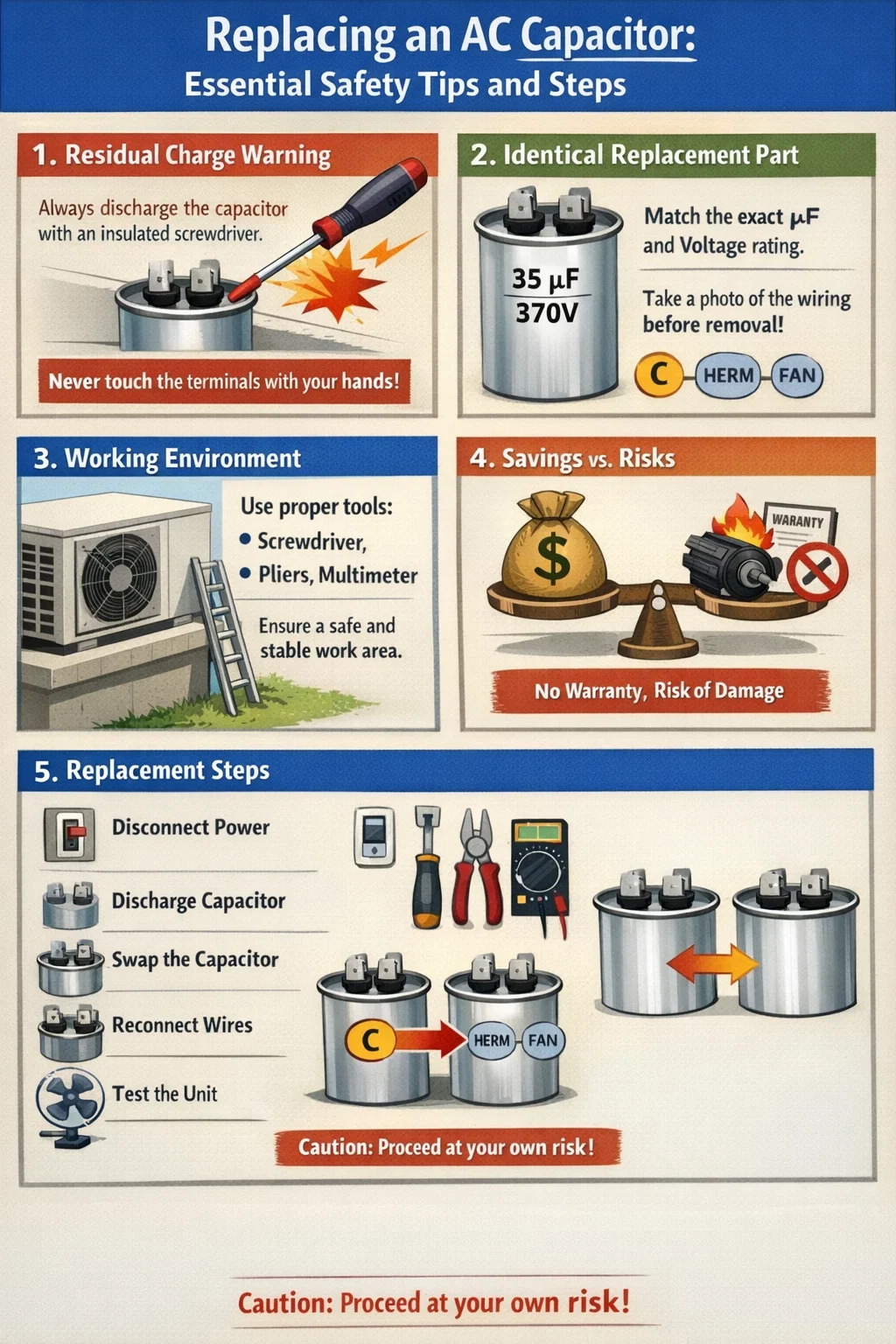
1. It's a component with "residual charge"
This is the point that beginners most easily overlook. An AC capacitor is essentially an energy storage device; even if you unplug your air conditioner, it may still contain a large amount of electricity.
Dangerous action: If you touch the terminals directly with your hands, even if the air conditioner has been unplugged for half an hour, it can still give you a nasty shock.
Correct procedure: You must use a screwdriver with an insulated handle and simultaneously touch both terminals to discharge the capacitor. Only proceed after confirming there is no residual charge.
2. You must find the correct "identical" replacement part
Replacing a capacitor isn't as simple as buying any round can and plugging it in. Every AC capacitor has key parameters on its side (such as capacitance in μF and voltage rating in V).
Compatibility: The parameters of the new capacitor must be exactly the same as the old one. If the value is too low, the compressor won't work; if it's too high, the motor can easily overheat and burn out.
Take a photo for reference: Before disconnecting the wires from the old capacitor, be sure to take a clear photo with your phone. The capacitor usually has three terminals: C, HERM, and FAN. If you connect them incorrectly, you could directly ruin the expensive compressor.
3. You need a basic "working environment"
The outdoor unit of an air conditioner is usually mounted at a height or placed on a narrow balcony.
Environmental factors: If you need to climb a tall ladder, or the outdoor unit is in a very awkward position, the risks of doing it yourself increase exponentially.
Tool preparation: In addition to the new capacitor, you will need at least a screwdriver, needle-nose pliers, and ideally a multimeter that can measure capacitance to confirm whether the old capacitor is actually broken.
4. Weighing the "Savings" and "Risks"
Doing it yourself can indeed save you a few hundred yuan in labor costs, but you also need to consider the following consequences:
No warranty: Parts replaced by a technician usually come with a one-year warranty. If the part you replace yourself burns out after a couple of days, or if improper installation damages the motor, the loss will be far more than a few hundred yuan.
Warranty voided: If your air conditioner is still under warranty, replacing the AC capacitor yourself may void the manufacturer's warranty.
5. Simple Operating Procedure (For reference only)
Completely disconnect the power: Turn off the indoor switch and the outdoor circuit breaker.
Open the cover and discharge the capacitor: Open the side panel of the outdoor unit and discharge the capacitor using an insulated screwdriver.
Take pictures and note the wiring: Remember the color of each wire and its corresponding connector.
Replace the part: Replace the old capacitor with the new one, connect the wires, and secure it firmly.
Test the unit: Turn on the power and check if the fan and compressor start normally.

- Tel: +86-13600614158
- E-mail: mina@cxriyi.com
- Address: Zonghan Street,Cixi City, Zhejiang Province, China.
Copyright © CIXI RIYI CAPACITOR FACTORY
All Rights Reserved.
