
 en
en
 English
What is the average lifespan of an AC capacitor? Let's find out.
It's impossible to give a precise lifespan for an AC capacitor, like an expiration date. It's more like car tires; some last for years, while others need replacing after only six months due to extreme road conditions.
Generally, we can look at the following factors that affect its "lifespan":
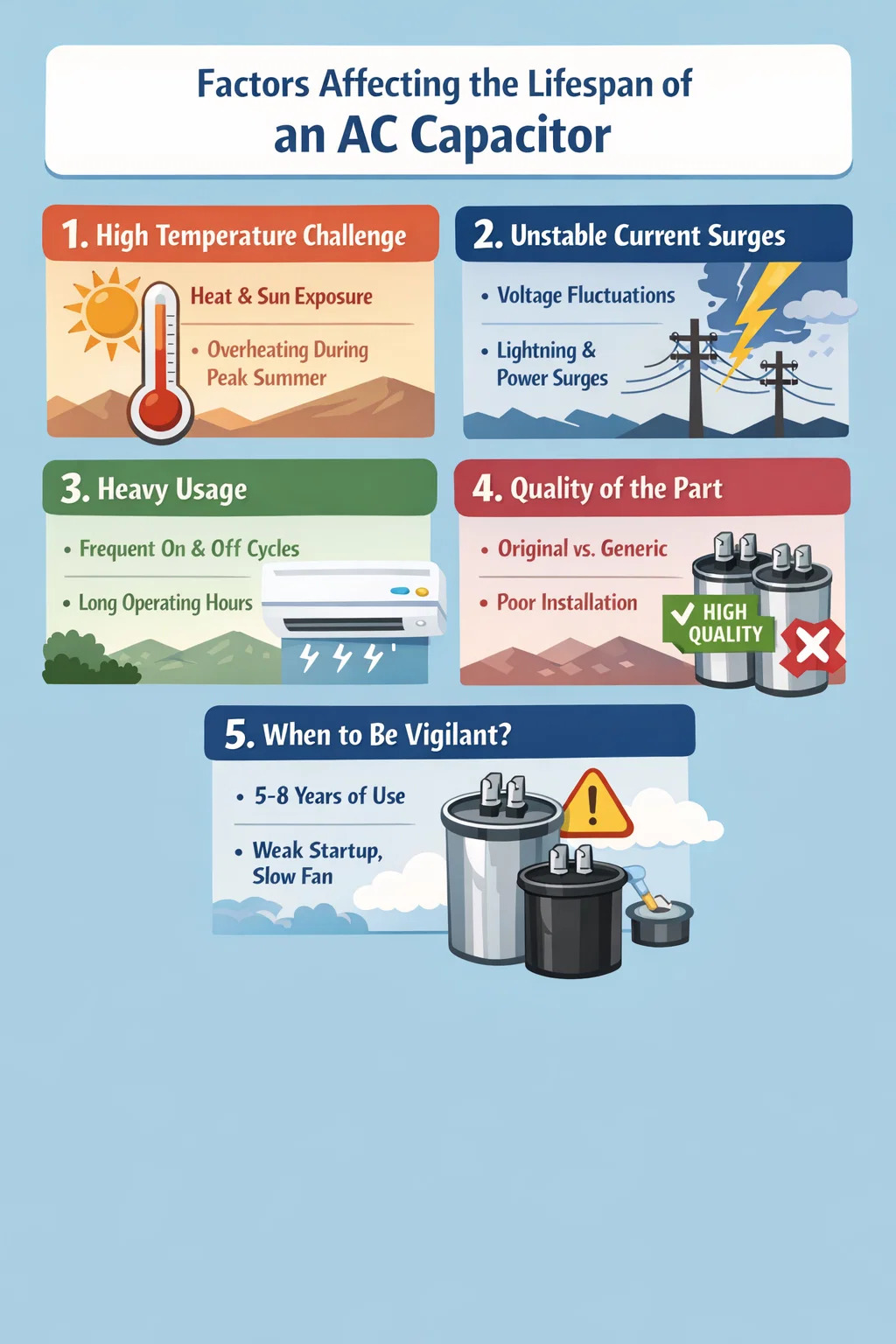
1. The Unavoidable "High Temperature Challenge"
AC capacitors are notoriously sensitive to heat.
Environmental factors: If your air conditioner's outdoor unit is constantly exposed to direct sunlight or placed in a poorly ventilated corner, the chemical substances inside the capacitor will dry out or expand due to high temperatures.
Vicious cycle: The hottest summer temperatures are precisely when the capacitor works the hardest. Many capacitors "overheat" and fail under continuous high temperatures and full load operation.
2. Fear of Unstable "Current Surges"
The quality of the power grid also determines its lifespan.
Voltage fluctuations: If the voltage around your home is unstable, frequently fluctuating, the AC capacitor has to repeatedly charge and discharge to balance the current. This frequent "stressful work" accelerates the aging of its internal materials.
Lightning strikes and power surges: An occasional lightning strike or a sudden surge of current when the power grid is restored can instantly kill a capacitor that would otherwise last for several years.
3. The Intensity of "Heavy Work"
How frequently the air conditioner is used greatly affects its lifespan.
Number of starts: The capacitor works hardest during startup. If you frequently turn the air conditioner on and off, or if the thermostat is set incorrectly, causing the compressor to start and stop frequently, the AC capacitor will wear out very quickly.
Long-term standby: Even when not cooling, as long as the air conditioner is powered on, some capacitors are in a weak working state, and this continuous operation over time will gradually wear them out.
4. The "Quality" of the Part Itself
This is like buying home appliances and considering the brand; capacitors of different quality have vastly different lifespans.
Original vs. generic parts: High-quality original capacitors can usually withstand harsher environments. Some inferior replacement parts, while cheaper, have poor sealing and pressure resistance, and may fail after just one summer. Installation process: If the terminals are not tightened properly, or if the contact points are corroded, the increased resistance will generate excessive heat, which can directly burn out the capacitor.
5. When should you be vigilant?
Although some capacitors can last ten years, and others only two or three, you don't need to wait until it completely fails before taking action.
The five-to-eight-year mark: For most ordinary household air conditioners, the performance of the AC capacitor begins to decline after five or six years of use.
Warning signs: If you notice that the air conditioner's starting sound becomes muffled, or the outdoor unit's fan rotates slowly, it might be telling you: "I'm failing, replace me quickly."

- Tel: +86-13600614158
- E-mail: mina@cxriyi.com
- Address: Zonghan Street,Cixi City, Zhejiang Province, China.
Copyright © CIXI RIYI CAPACITOR FACTORY
All Rights Reserved.
