
 en
en
 English
CBB60 vs CBB61 Capacitors: Can One Replace the Other?
Direct Answer: Can a CBB61 Replace a CBB60 Capacitor?
In most cases, a CBB61 capacitor cannot directly replace a CBB60 capacitor, and vice versa — even if the capacitance value and voltage rating appear identical on paper. These two capacitor types are engineered for fundamentally different circuit roles. The CBB60 is a run capacitor designed specifically for single-phase AC motor starting and running applications where the capacitor remains in the circuit permanently during operation. The CBB61 , by contrast, is optimized for use in fan motor circuits, typically ceiling fans, stand fans, and similar loads, and operates under different thermal, current, and mechanical stress conditions.
Swapping one for the other without careful verification of all electrical parameters — not just capacitance and voltage — risks motor failure, overheating, reduced efficiency, or even a safety hazard. That said, in certain scenarios with matching specifications across all relevant parameters, a substitution may be technically acceptable. This article breaks down every factor you need to evaluate before making that decision.
What Is a CBB60 Capacitor and Where Is It Used?
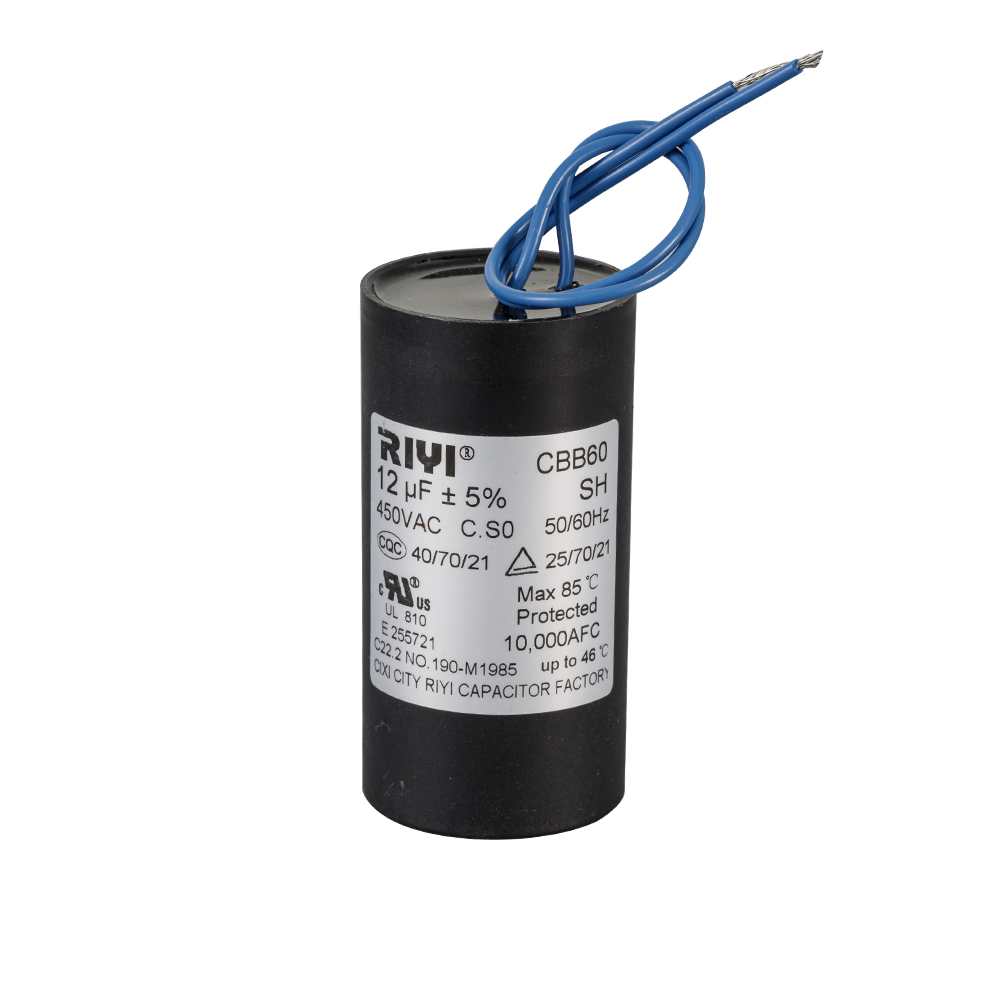
The CBB60 capacitor is a metalized polypropylene film capacitor housed in a cylindrical plastic case, typically with axial or radial wire leads or screw terminals. It belongs to the "motor run" category — meaning it stays connected to the motor windings during the entire running cycle, not just at startup. This makes the CBB60 capacitor subject to continuous electrical stress, and its design reflects that requirement.
Common applications for the CBB60 capacitor include:
- Water pump motors (submersible and surface-mounted)
- Air compressor motors
- Washing machine motors
- Single-phase induction motors for industrial machinery
- Pool and spa pump motors
- Agricultural irrigation pump motors
A typical CBB60 capacitor operates at rated voltages of 250VAC or 450VAC, with capacitance values commonly ranging from 2µF to 100µF. The operating temperature range is generally –40°C to +70°C. Because these motors often run for hours at a stretch — a pump motor may run continuously for many hours per day — the CBB60 capacitor must tolerate sustained thermal and electrical stress without significant capacitance drift or dielectric breakdown.
The cylindrical form factor of most CBB60 capacitors is a practical choice: it provides a good surface area-to-volume ratio for heat dissipation, and the polypropylene dielectric offers excellent self-healing properties. When a localized dielectric breakdown occurs (a micro-fault), the thin metallization layer at that point vaporizes, effectively isolating the fault and preserving capacitor function. This self-healing behavior is critical in continuous-run applications.
What Is a CBB61 Capacitor and How Does It Differ in Design?
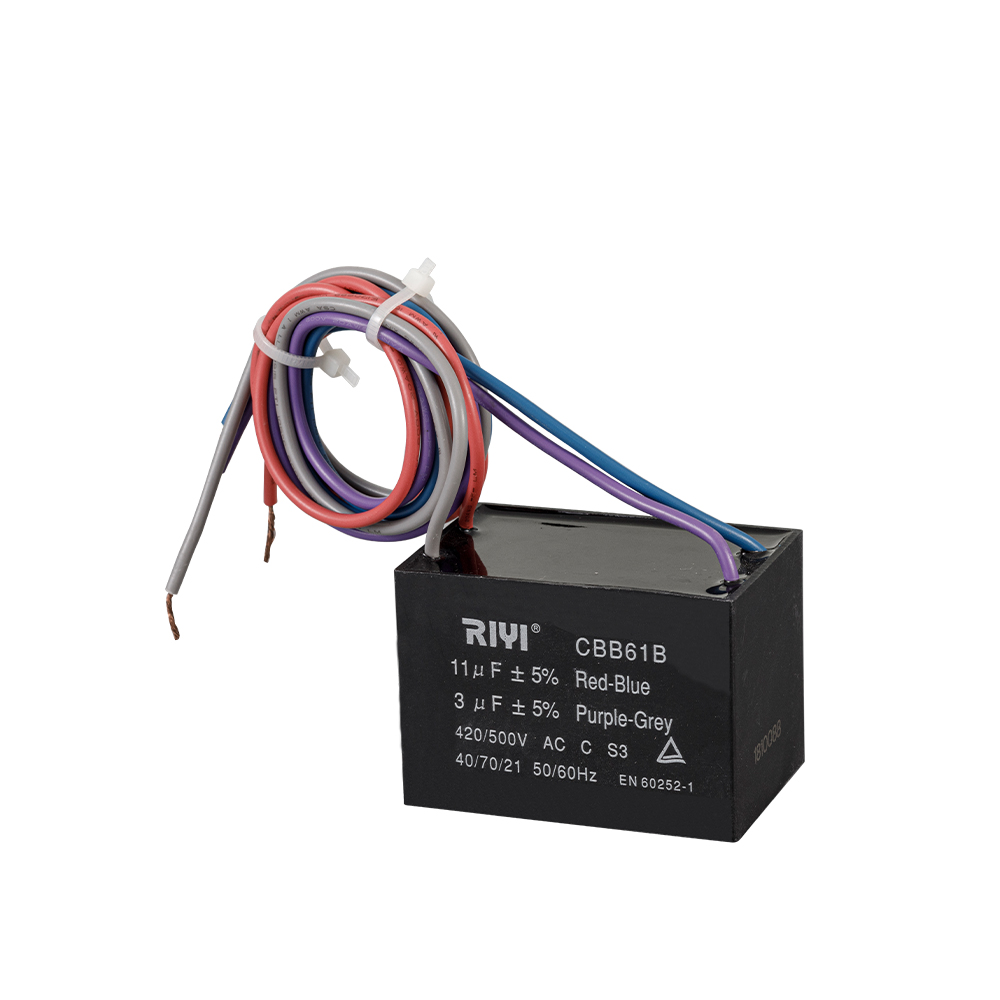
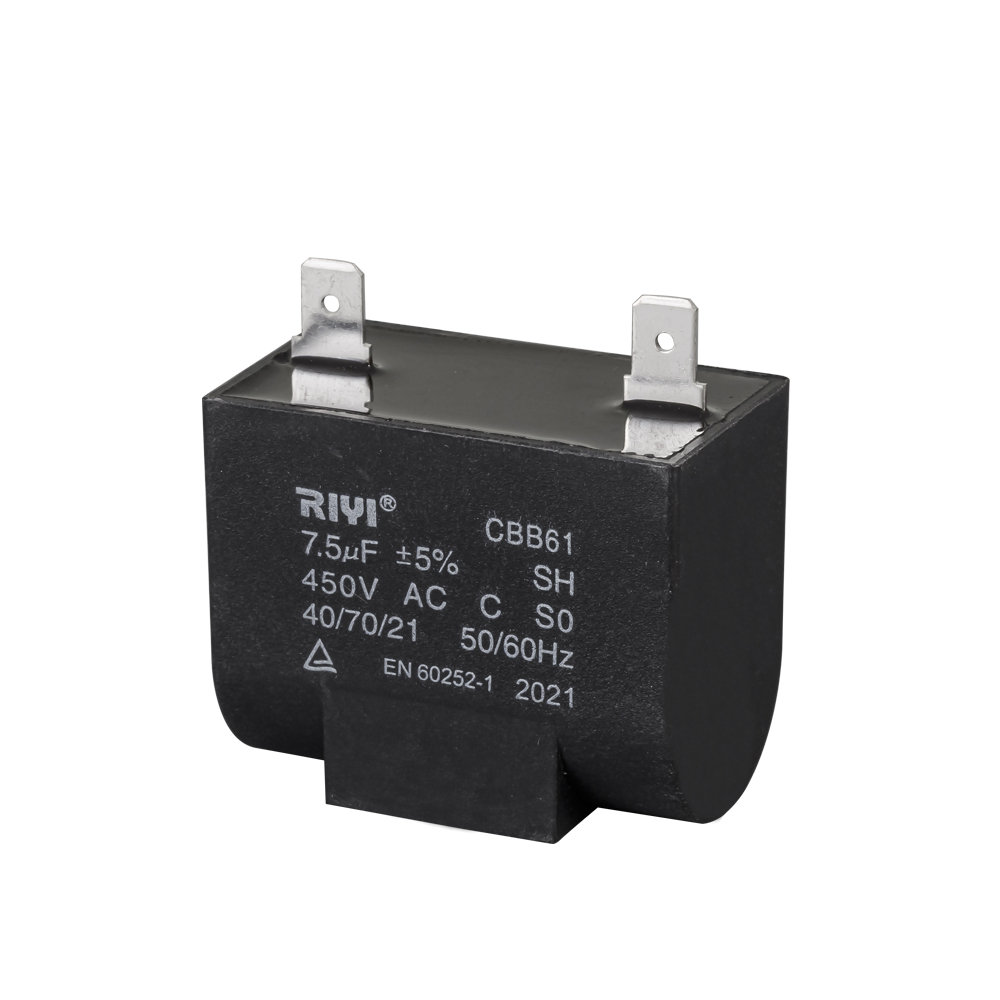
The CBB61 capacitor is also a metalized polypropylene film capacitor, but it is packaged in a flat, rectangular plastic case — a form factor specifically chosen for installation inside the housing of ceiling fans and pedestal fans, where space is constrained and flat mounting is more practical. The CBB61 is likewise a motor run capacitor, used in single-phase fan motors to split the phase and create the rotating magnetic field needed for rotation.
Common applications for the CBB61 capacitor include:
- Ceiling fan motors
- Stand fans and wall fans
- Exhaust fans and ventilation fans
- Range hood motors
- Small HVAC fan units
CBB61 capacitors are rated at 250VAC or 450VAC, and their capacitance values typically range from 1µF to 20µF — a narrower range compared to CBB60, reflecting the lower power demands of fan motors. The flat rectangular body is often fitted with quick-connect terminals (spade connectors) that match the wiring harness of fan motor assemblies.
Fan motors generally draw far less current than pump or compressor motors. A typical ceiling fan motor might draw 0.3A to 0.8A, while a water pump motor could draw 3A to 15A or more. This difference in current demand is reflected in the internal construction of the two capacitor types — wire gauge, lead thickness, and terminal design all account for the expected current load.
Side-by-Side Comparison: CBB60 vs CBB61
The table below summarizes the key technical and physical differences between the two capacitor types to help clarify why a direct substitution is not always straightforward.
| Parameter | CBB60 | CBB61 |
|---|---|---|
| Physical Shape | Cylindrical | Flat rectangular |
| Typical Capacitance Range | 2µF – 100µF | 1µF – 20µF |
| Voltage Rating | 250VAC / 450VAC | 250VAC / 450VAC |
| Primary Application | Pump, compressor, washing machine motors | Fan motors (ceiling, stand, exhaust) |
| Terminal Type | Wire leads or screw terminals | Spade (quick-connect) terminals or wire leads |
| Typical Motor Current | 3A – 15A+ | 0.3A – 1.5A |
| Operating Temperature | –40°C to +70°C | –40°C to +70°C |
| Self-Healing | Yes | Yes |
| IEC/GB Standard | GB/T 3667.1 | GB/T 3667.1 |
The Five Parameters That Determine Whether a Replacement Is Safe
Before substituting a CBB61 for a CBB60 (or the reverse), every one of the following parameters must match or exceed the requirements of the original capacitor. Missing even one can damage the motor or the capacitor itself.
1. Capacitance Value (µF)
The capacitance value must match exactly. Motor windings are tuned to a specific phase shift, and the capacitance determines how much phase displacement occurs between the main winding and auxiliary winding. Even a 10% deviation in capacitance can cause the motor to run hot, reduce torque output significantly, or fail to start under load. For example, a pump motor specified for a 20µF CBB60 capacitor will struggle if fitted with an 18µF or 22µF unit — and most CBB61 capacitors do not even come in values above 20µF, making them unsuitable for many pump motor applications that call for 30µF, 40µF, 50µF, or higher values.
2. Voltage Rating (VAC)
The replacement capacitor must have a voltage rating equal to or higher than the original. Installing a 250VAC capacitor in a circuit designed for 450VAC is a serious safety risk — the dielectric will break down under over-voltage conditions, potentially causing the capacitor to fail with fire or explosion. Both CBB60 and CBB61 capacitors are available in 250VAC and 450VAC variants, so this parameter is often compatible, but always verify the label on the original before sourcing a replacement.
3. Current-Handling Capacity
This is where substitution is most likely to go wrong in the CBB60-to-CBB61 direction. A CBB61 capacitor designed for a fan motor circuit carrying 0.5A may have thinner internal metallization, narrower lead wire, and lighter-duty terminal connections than a CBB60 designed for a pump motor circuit carrying 6A. Forcing a CBB61 into a pump motor application may cause the capacitor to overheat internally, accelerating dielectric aging and leading to premature failure — sometimes within days or weeks rather than the expected service life of 5–10 years. The reverse substitution (CBB60 into a fan motor circuit) is usually safer from a current standpoint, since the CBB60 is overbuilt for the lower current demand of fan motors, though it introduces other complications discussed below.
4. Physical Dimensions and Mounting
The cylindrical body of a CBB60 capacitor will not fit in the flat rectangular mounting bracket of a ceiling fan housing designed for a CBB61. Conversely, a flat CBB61 cannot be strapped into the cylindrical clamp bracket typically used for pump motor CBB60 mounting. This is not merely a cosmetic issue — improper mechanical mounting can lead to vibration damage, intermittent electrical contact, and insulation wear on lead wires. Always verify that the replacement physically fits and can be properly secured.
5. Capacitance Tolerance and Dissipation Factor
Most motor run capacitors carry a tolerance of ±5% or ±10%. The dissipation factor (tan δ) indicates energy loss within the capacitor — a higher tan δ means more internal heating during operation. For continuous-run applications like pump motors, a low dissipation factor is essential. CBB60 capacitors are typically specified with tan δ ≤ 0.001 at 1kHz, and high-quality CBB61 units meet similar specifications. However, budget CBB61 units sourced from unverified suppliers may have higher dissipation factors that cause excessive self-heating in demanding applications.
Real-World Scenarios: When Substitution Works and When It Fails
Scenario A: Replacing a CBB61 in a Ceiling Fan with a CBB60
Suppose your ceiling fan uses a 4µF/250VAC CBB61 capacitor that has failed. You have a 4µF/450VAC CBB60 capacitor on hand. Can you use it?
Electrically, yes — the capacitance matches, and the higher voltage rating is not a problem. The CBB60 is more robust than the fan application demands, which generally means it will function without issue. The main obstacles are physical: the cylindrical CBB60 may not fit inside the fan housing designed for a flat CBB61, and the terminal type may differ (screw or wire leads vs. spade connectors). If you can fabricate a mounting solution and adapt the wiring, the substitution can work as a temporary or emergency fix. For a permanent repair, sourcing the correct CBB61 is always preferred.
Scenario B: Replacing a CBB60 in a Water Pump with a CBB61
A 1.5kW submersible pump motor uses a 30µF/450VAC CBB60 capacitor. No CBB61 capacitor in the market is rated at 30µF — the CBB61 product line simply does not extend to that capacitance value. This substitution is impossible by definition.
Even if the capacitance value were within range — say, a 10µF pump motor and a 10µF CBB61 available — the current-handling mismatch, physical form factor difference, and terminal type differences all create practical barriers. In a high-demand motor application like a pump or compressor, using an undersized capacitor risks thermal runaway inside the capacitor, followed by dielectric failure. This is not a theoretical risk: field technicians routinely see pump motors returned with burned or exploded capacitors when incorrect types are installed.
Scenario C: Replacing a CBB61 in an Exhaust Fan with Another CBB61 of a Different Brand
This is actually the most common repair scenario and requires no cross-type substitution at all. Provided the replacement CBB61 matches in capacitance (e.g., 2.5µF), voltage rating (250VAC), and terminal type, different brands of CBB61 are fully interchangeable. The CBB60 vs CBB61 dilemma does not arise here.
Understanding the CBB Naming System
The "CBB" designation comes from the Chinese national standard for capacitor nomenclature. Breaking down the code helps clarify the relationship between different types:
- C — Capacitor (generic identifier)
- B — Polypropylene film (bopet/biaxially oriented polypropylene)
- B — Metalized electrode type
- 60 — Sub-type code: cylindrical motor run capacitor for general single-phase AC motor applications
- 61 — Sub-type code: flat case motor run capacitor for fan motor applications
The sub-type number (60 vs 61) specifically encodes the physical package and intended application — not just an arbitrary serial number. This is why the two types are not interchangeable by definition in any standards-compliant repair scenario. Other related types in the CBB family include CBB65 (aluminum case, for air conditioner compressor motors) and CBB80 (impregnated paper dielectric, for lighting applications), each representing a distinct package and application class.
How to Identify a Failed CBB60 or CBB61 Capacitor
Correctly diagnosing capacitor failure before ordering a replacement prevents the frustration of replacing the wrong component. Here are the most reliable methods:
Visual Inspection
A failed capacitor often shows physical signs: bulging of the top or body, cracks in the plastic casing, discoloration from heat, or a burning smell. A CBB60 capacitor with a visibly swollen body has experienced internal pressure buildup from dielectric breakdown — it should be replaced immediately and not re-energized. Not all failed capacitors show external signs, however.
Capacitance Measurement
Disconnect the capacitor from the circuit entirely and discharge it (short the terminals briefly through a resistor). Then use a digital multimeter with a capacitance measurement function, or a dedicated LCR meter, to measure the actual capacitance. A reading more than 10% below the rated value indicates significant capacitance loss and warrants replacement. An open-circuit reading (infinite resistance) indicates complete dielectric failure. A short-circuit reading (near-zero resistance) means the dielectric has been completely destroyed.
Motor Symptom Diagnosis
Capacitor failure in a motor circuit typically presents as one or more of these symptoms:
- Motor hums but does not start (especially under load)
- Motor runs at reduced speed or with noticeably less torque
- Motor overheats during normal operation
- Fan rotates slowly or inconsistently at all speed settings
- Pump motor trips the thermal overload protection repeatedly
- Increased running current draw compared to nameplate rating
Selecting the Correct Replacement CBB60 Capacitor
When replacing a failed CBB60 capacitor, follow this checklist to ensure the correct part is sourced:
- Read the label on the old capacitor. The label should show the capacitance in µF, the voltage rating (e.g., 450VAC), the frequency rating (50Hz or 60Hz), and possibly the temperature class.
- Match capacitance exactly. Do not substitute a 25µF unit for a 20µF unit "because it's close." The motor manufacturer specified that value for a reason.
- Match or exceed the voltage rating. A 450VAC rated CBB60 can replace a 250VAC rated unit of the same capacitance (with no electrical downside), but never install a lower voltage rating than specified.
- Verify the terminal type. Wire leads, screw terminals, and spade terminals are not always interchangeable without adaptation.
- Check physical dimensions. Ensure the replacement fits in the mounting bracket or space provided on the motor or control panel.
- Source from reputable suppliers. Counterfeit and substandard capacitors are widespread in the market. Capacitors from unknown sources may fail to meet rated specifications, leading to rapid failure or motor damage.
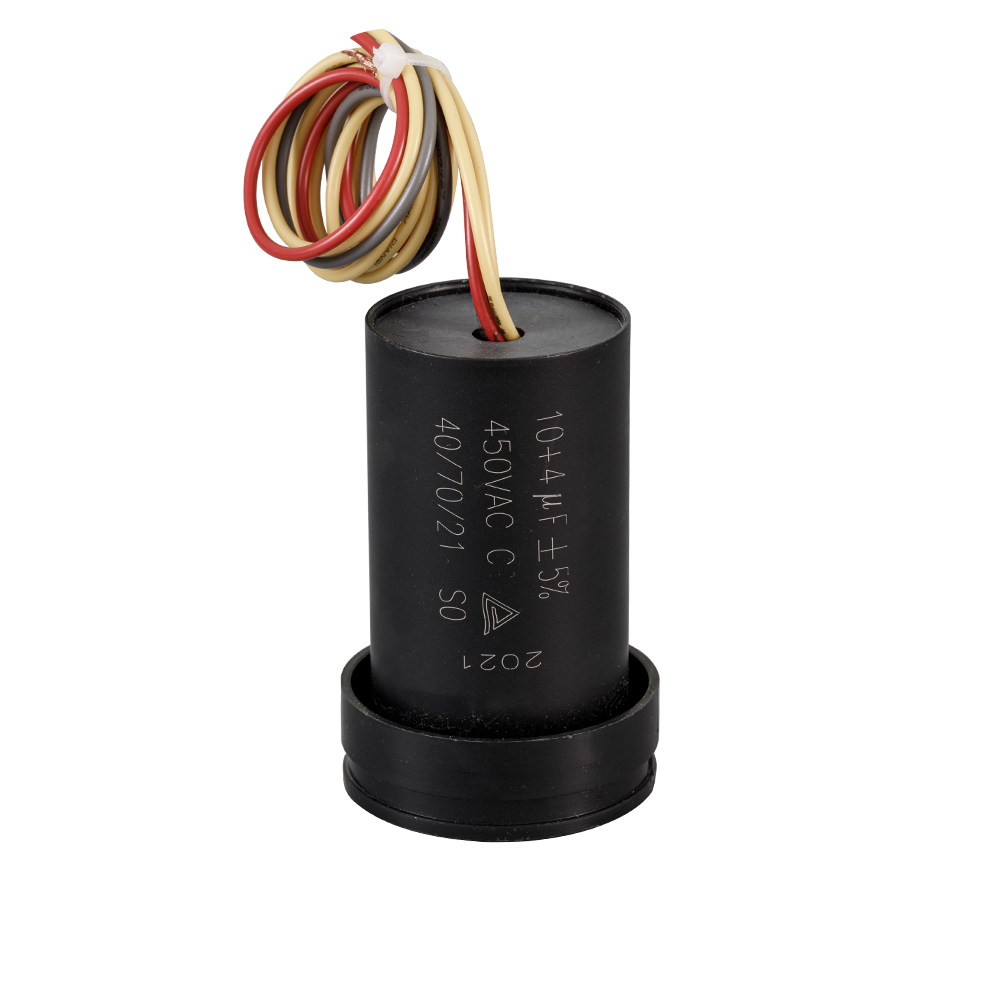
For CBB61 replacement in fan motors, the same checklist applies — with the additional note that many ceiling fans use dual-capacitor configurations, where a single dual-section CBB61 provides two different capacitance values (for example, 3µF + 4µF in one housing) to serve different speed taps. In these cases, the entire dual-section unit must be replaced with one of matching configuration, not two separate single-section capacitors unless the wiring is adapted accordingly.
Capacitor Lifespan and Maintenance Considerations
Both CBB60 and CBB61 capacitors are rated for a service life of approximately 10,000 operating hours under nominal conditions, which translates to roughly 5–10 years in typical residential or light commercial use. Several factors accelerate aging:
- Elevated ambient temperature: Every 10°C rise above the rated temperature roughly halves the capacitor's service life, according to Arrhenius aging models. A CBB60 capacitor mounted directly on a hot motor housing that exceeds 70°C will fail far sooner than its rated lifespan.
- Voltage spikes: Transient over-voltages from the power grid, lightning strikes (even with surge protection), or capacitive switching can stress the dielectric beyond its rating, reducing life or causing immediate failure.
- Humidity and moisture: Despite the sealed plastic housing, moisture ingress over many years can degrade the dielectric. CBB60 capacitors used in outdoor pump applications or high-humidity environments should be installed with waterproof housings or enclosures.
- Frequent starts and stops: Each start-up cycle subjects the capacitor to a brief inrush of current higher than steady-state running current. Motors that cycle on and off hundreds of times per day (like refrigeration compressors or irrigation pump controllers) will age their run capacitors faster than motors that run continuously for long periods.
For equipment in critical applications — commercial refrigeration, irrigation systems, industrial machinery — proactive capacitor replacement on a schedule (every 5–7 years) is a lower-cost approach than waiting for a failure that takes the entire motor or system offline.
Safety Precautions When Handling Motor Run Capacitors
Motor run capacitors can retain a lethal charge even after the power is disconnected. Before handling any CBB60 or CBB61 capacitor for testing or replacement:
- Disconnect power completely at the circuit breaker or isolator, and verify with a voltage tester that no voltage is present before touching any wiring.
- Discharge the capacitor using a discharge tool or a resistor (a 20kΩ, 5W resistor is appropriate for most applications) before touching the terminals. Touching a charged capacitor directly can deliver a severe or fatal electric shock.
- Do not short the terminals directly with a screwdriver or bare wire — this causes a violent discharge arc that can damage the capacitor, the tool, and potentially injure you.
- Wear insulated gloves and eye protection when working near capacitors in motor control panels.
- Dispose of failed capacitors correctly. Polypropylene film capacitors do not contain hazardous materials like PCBs (which older oil-filled capacitors did), but they should be disposed of according to local electronic waste regulations.
Summary: The Bottom Line on CBB60 vs CBB61 Substitution
The CBB60 and CBB61 are related but distinct products within the metalized polypropylene film capacitor family.

- Tel: +86-13600614158
- E-mail: mina@cxriyi.com
- Address: Zonghan Street,Cixi City, Zhejiang Province, China.
Copyright © CIXI RIYI CAPACITOR FACTORY
All Rights Reserved.
