
 en
en
 English
How do I tell if my AC capacitor is bad? I'll tell you.
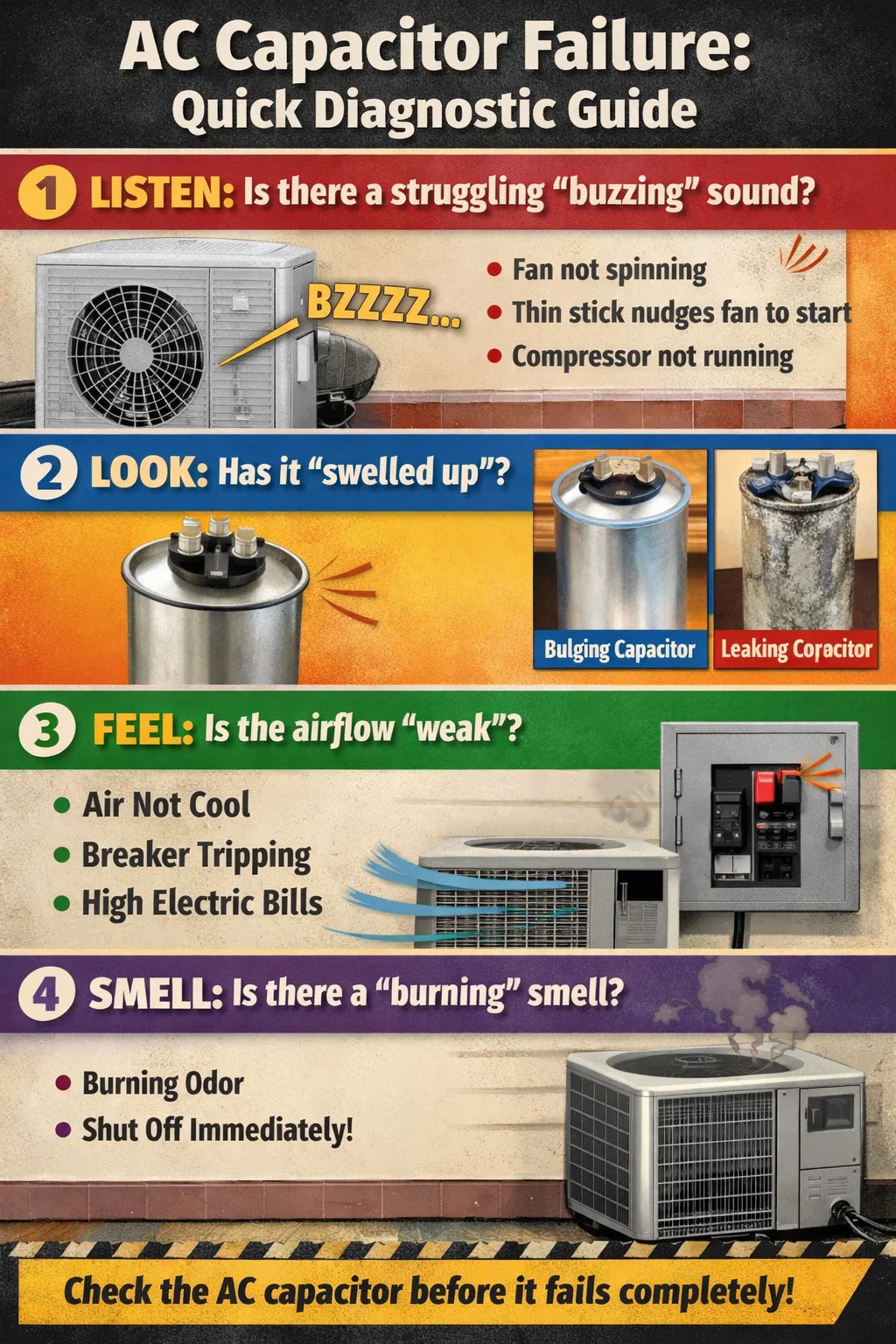
When your air conditioner starts acting up, the AC capacitor is often the easiest part to fail and also the easiest to diagnose. You don't need to disassemble complex circuitry; you can roughly determine if it needs replacing using these simple methods:
1. Listen: Is there a struggling "buzzing" sound?
When you turn on the air conditioner, if you hear a continuous "buzzing" sound from the outdoor unit, but the fan isn't spinning, or the compressor isn't starting, this is usually a typical sign of capacitor failure.
Principle: The AC capacitor is like the hand that gives the motor a push. If the capacitor is broken, the motor can't exert its full power and can only "struggle" in place, making a muffled sound.
Try this: If the fan isn't spinning, an experienced technician might use a thin wooden stick to nudge the fan blades. If it starts spinning after a nudge, it's almost certainly the starting capacitor that's broken.
2. Look: Has it "swelled up"?
This is the most intuitive method of diagnosis. You can observe the silver metal can (the AC capacitor) in the outdoor unit:
Bulging: A normal capacitor should have a flat top. If the top is bulging, like an inflated bread roll, it means it's completely broken.
Leaking: If there is oily liquid leaking around the can, or if it looks rusty or cracked, this also indicates internal damage.
3. Feel: Is the airflow "weak"?
If the air conditioner is still blowing air, but you feel:
The air isn't cool: The outdoor compressor isn't starting due to the faulty capacitor, causing the air conditioner to only blow room-temperature air like a regular fan.
Frequent tripping of the circuit breaker: A broken capacitor can cause unstable current, and to protect the circuit, the household circuit breaker may trip frequently.
Soaring electricity bills: If the capacitor isn't completely broken but is "weak," the motor will have to work harder, which will show up as unusually high electricity bills for those months.
4. Smell: Is there a "burning" smell?
Near the outdoor unit of the air conditioner, if you smell a burning plastic or pungent metallic odor, this is often a precursor to the AC capacitor overheating and burning out. In this case, you must turn off the unit immediately.

- Tel: +86-13600614158
- E-mail: mina@cxriyi.com
- Address: Zonghan Street,Cixi City, Zhejiang Province, China.
Copyright © CIXI RIYI CAPACITOR FACTORY
All Rights Reserved.
