
 en
en
 English
How to test ac capacitor with multimeter? | good vs bad capacitor live test
Determining whether an AC capacitor in an air conditioner is good or bad doesn't require professional electronics engineering knowledge. As long as you have a multimeter with a "capacitance test" function, you can follow these steps and become a semi-expert yourself.
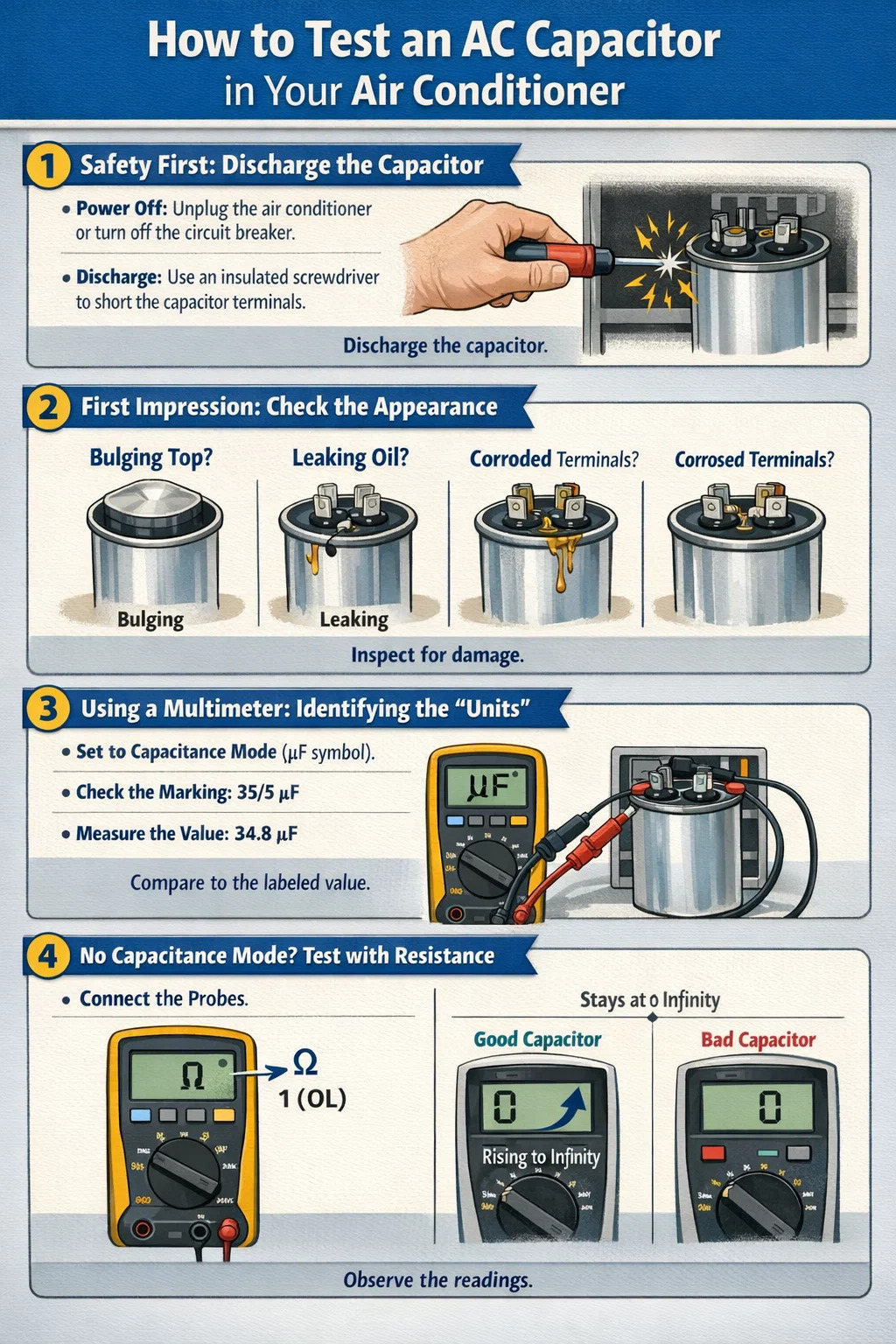
1. Safety First: Discharge the Capacitor
This step is the most important before you start testing. An AC capacitor is like a battery; even after the power is off, it may still hold a high-voltage charge, and touching it directly could result in a severe electric shock.
Power Off: Unplug the air conditioner or switch off the circuit breaker.
Discharge: Find a screwdriver with a well-insulated handle and use the metal shaft to simultaneously touch the two (or three) terminals of the capacitor. If you hear a "pop" or see a small spark, it means the residual charge has been discharged.
2. First Impression: Check the Appearance
Some faulty AC capacitors don't even need to be tested with an instrument; you can tell just by looking at them:
Bulging: The top of the capacitor should be flat. If it's bulging like fermented bread, it's definitely broken.
Leaking Oil: If there is oily liquid leaking from the bottom or top, it indicates internal damage.
Corrosion: Severely corroded terminals can also lead to poor contact.
3. Using a Multimeter: Identifying the "Units"
Set the multimeter to the capacitance measurement range (usually marked with the symbol –|(– or labeled nF/μF).
Check the markings: Each AC capacitor will have its capacitance value written on its side. For example, "35/5 μF" means it's a dual capacitor, with the larger one being 35 and the smaller one being 5.
Measure the actual value: Place the multimeter probes on the corresponding terminals (e.g., "C" and "HERM" to measure the compressor section, "C" and "FAN" to measure the fan section).
Compare: If the measured value is significantly different from the marked value (e.g., marked 35, but the measurement is only 10, or there's no reading at all), it means the capacitor is "weak" and needs to be replaced.
4. What if there's no capacitance range? Use the resistance range to "listen to its heartbeat"
If your multimeter doesn't have a dedicated capacitance measurement function, you can use the resistance range (Ω) to roughly assess it:
Dynamic observation: Connect the probes and observe the numbers on the screen. A good capacitor will show a small number that quickly increases and finally displays infinity (or "1"/"OL").
Principle: This is because the battery in the multimeter is charging the capacitor. If the number remains unchanged or always displays 0, then the AC capacitor is definitely defective.
5. Common signs of good and bad capacitors
| Status | Multimeter Reading | Conclusion |
| Good | Reading is within ±5% to 10% of the rated value on the label. | Healthy. The capacitor is working fine; no need to replace. |
| Weak | Reading is significantly lower than the rating (e.g., labeled 45µF but reads 20µF). | Failing. The AC might still run, but it wastes electricity and can overheat or damage the compressor. |
| Bad | Reading is 0, near zero, or the meter shows "OL" (Open Loop). | Dead. The capacitor has completely failed. The AC unit will not start; replace it immediately. |

- Tel: +86-13600614158
- E-mail: mina@cxriyi.com
- Address: Zonghan Street,Cixi City, Zhejiang Province, China.
Copyright © CIXI RIYI CAPACITOR FACTORY
All Rights Reserved.
