
 en
 English

How Does a Motor Capacitor Work? Principles, Ratings, and Replacement Guide
Content
- 1 Why Single-Phase Motors Cannot Start Without a Capacitor
- 2 How the Capacitor Produces a Rotating Magnetic Field
- 3 Start Capacitors, Run Capacitors, and Dual-Run Capacitors
- 4 Inside the Motor Capacitor: Metallized Film and Self-Healing
- 5 Key Ratings That Determine Performance and Lifespan
- 6 How Capacitance Value Affects Torque, Speed, and Efficiency
- 7 Failure Modes and Symptoms: What a Bad Motor Capacitor Looks Like
- 8 How to Match a Replacement Capacitor: A Practical Checklist
- 9 Why Manufacturing Quality and Testing Matter for Motor Capacitors
- 10 Frequently Asked Questions
- 11 Putting It Together: Matching the Capacitor to the Motor
A motor capacitor works by creating a phase shift between the current in the main winding and the current in the auxiliary winding of a single-phase AC motor. That phase shift produces a rotating magnetic field, which gives the motor the torque it needs to start and to keep running smoothly. Without a capacitor, a single-phase induction motor would just sit there humming, because its stationary pulsating field cannot produce net starting torque.
If you are repairing a pump, a washing machine, an air conditioner, or a ventilation fan, understanding how the capacitor does its job helps you choose the right replacement, spot a failing part early, and avoid burning out the motor. The rest of this article explains the physics in plain terms, shows the ratings that matter, and gives practical guidance on capacitance values, voltage ratings, and failure symptoms.
Why Single-Phase Motors Cannot Start Without a Capacitor
A single-phase AC supply produces a magnetic field that pulsates in one direction rather than rotating. In a simple induction motor with only a main winding, the rotor sees equal forces pushing it clockwise and counterclockwise at standstill. The net torque is zero, so the motor cannot start on its own. This is not a defect; it is a fundamental property of single-phase alternating current.
To create a rotating field, you need a second winding that carries current out of phase with the main winding. A capacitor placed in series with that auxiliary winding makes the current lead the voltage by nearly 90 electrical degrees. The result is a two-phase-like field that sweeps around the stator and drags the rotor into motion.
Once the motor reaches about 75% of its rated speed, many designs disconnect the auxiliary winding and its capacitor using a centrifugal switch. Other designs keep the capacitor in the circuit permanently to improve running torque and efficiency. The difference between these two arrangements explains why start capacitors and run capacitors have very different ratings and physical sizes.
How the Capacitor Produces a Rotating Magnetic Field
The capacitor does not generate energy. It stores energy in an electric field and releases it at a different time. When AC voltage is applied, the capacitor charges and discharges every half cycle. Because current through a capacitor leads the voltage across it by 90 degrees, the auxiliary winding current reaches its peak earlier than the main winding current.
The phase difference between the two currents depends on the capacitance value and the motor’s impedance. It is not exactly 90 degrees in practice, but it is enough to produce a rotating field. The capacitive reactance is calculated as Xc = 1 / (2 x pi x f x C), where f is frequency in hertz and C is capacitance in farads. For a 10 microfarad capacitor at 60 Hz, Xc is approximately 265 ohms. At 50 Hz, the same capacitor has about 318 ohms of reactance, which is why a capacitor rated for 50 Hz may behave differently on a 60 Hz supply.
The two windings are usually spaced 90 electrical degrees apart in the stator. When their currents are out of phase, the combined magnetic field rotates. The rotor follows that field because of electromagnetic induction. The stronger the phase shift and the closer it is to 90 degrees, the higher the starting torque.
Start Capacitors, Run Capacitors, and Dual-Run Capacitors
Motor capacitors fall into three practical categories. Knowing which one you are dealing with prevents mismatched replacements and repeat failures. The table below compares typical ratings and duties.
| Type | Typical Capacitance | Typical Voltage | Duty Cycle | Common Applications |
|---|---|---|---|---|
| Start capacitor | 70 to 500 microfarads | 125 to 330 VAC | Short bursts, seconds | Compressors, large fans |
| Run capacitor | 2 to 80 microfarads | 250 to 500 VAC | Continuous | Pumps, washing machines, blowers |
| Dual-run capacitor | Two values, e.g., 35/5 microfarads | 370 to 450 VAC | Continuous | Air conditioner compressors and fan motors |
Start capacitors provide a large burst of torque for a few seconds and then drop out. Run capacitors stay in the circuit and must handle continuous AC current, so they are built with metallized film and self-healing properties. Dual-run capacitors pack two run capacitors into one case: a larger section for the compressor and a smaller section for the condenser fan. For a deeper look at run capacitor behavior, see how a run capacitor works in continuous duty.
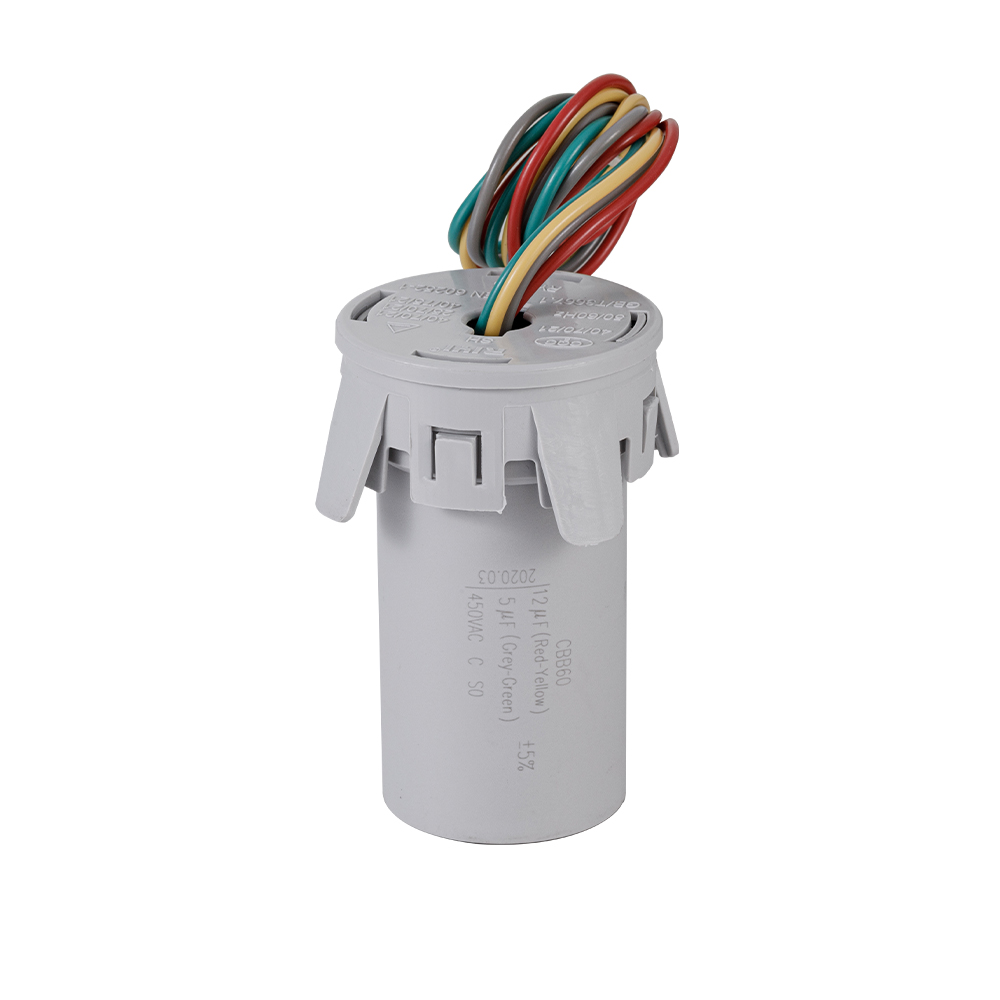
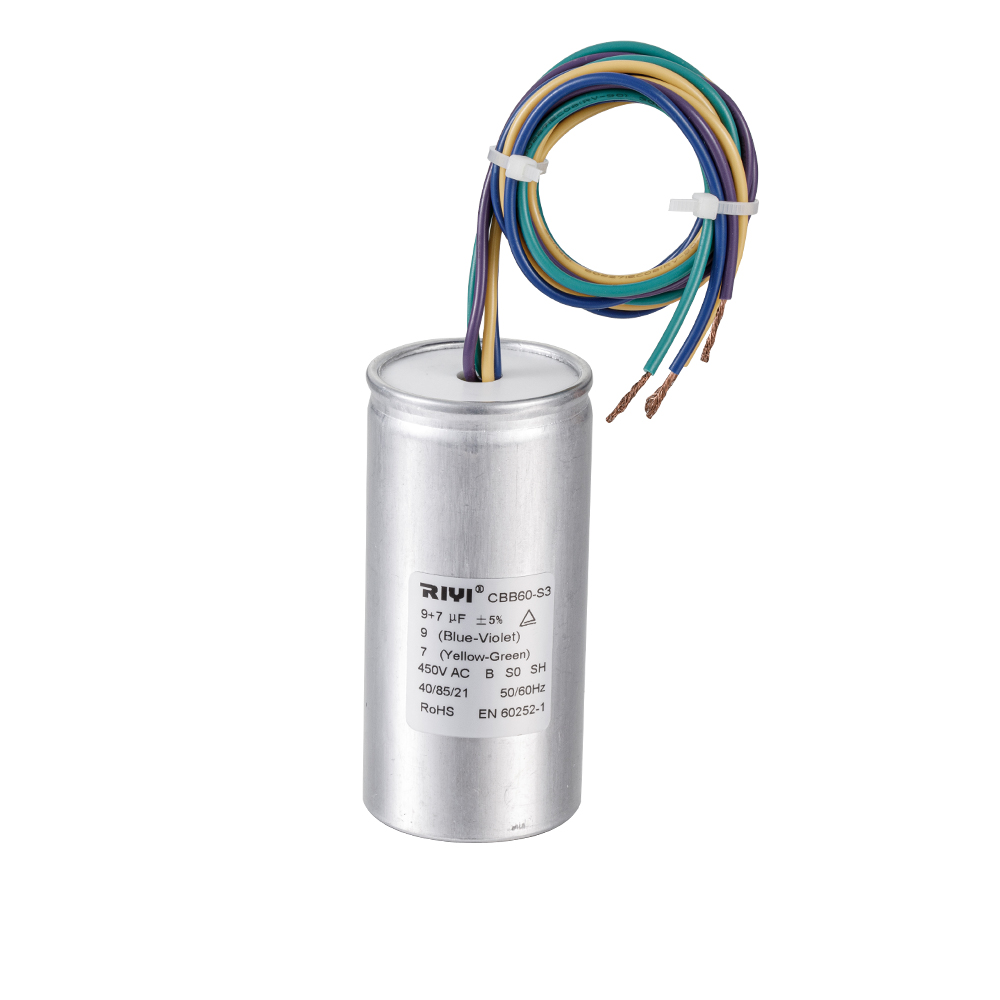 CBB60 AC Motor Run And Start Capacitor ManufacturersCBB60 450V B S0 Combination Lead Capacitor This CBB60 450V B S0 combination lead capacitor is, simply put, an indispensable "energy storage" and "booster" for AC motor...View Product →
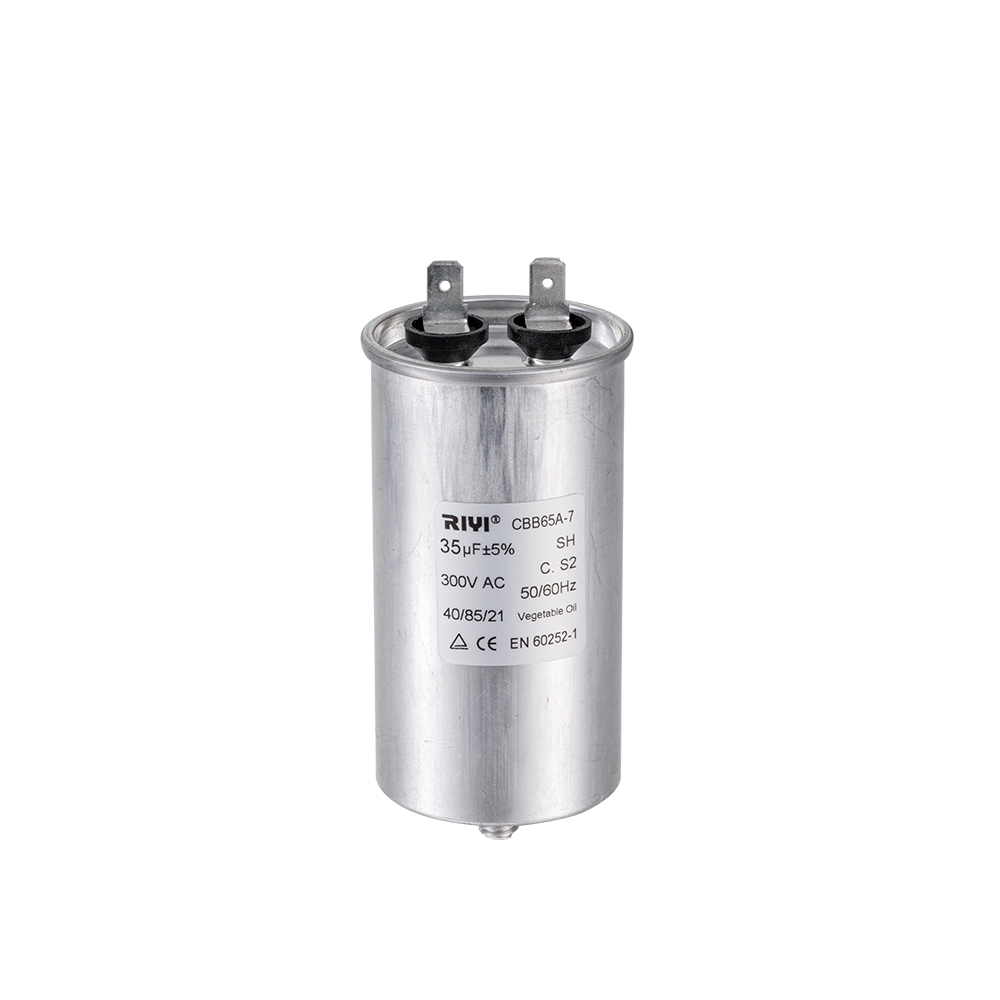
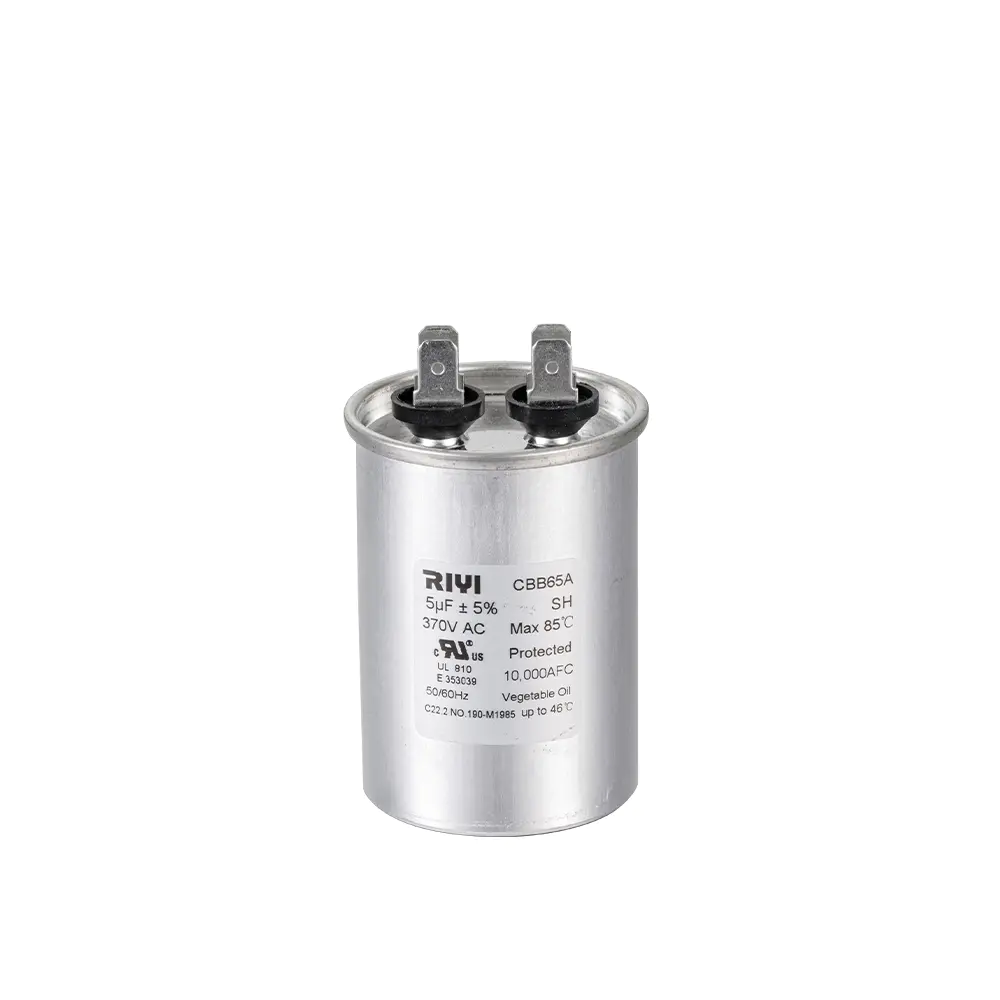 AC CBB65 Explosion-Proof Capacitor ManufacturersCbb65 5uf 370v S2 UL Explosion-Proof Aluminum Housing 2+2 terminal This capacitor essentially acts as a "voltage-stabilizing energy storage pump" in motor drive circui...View Product →
Inside the Motor Capacitor: Metallized Film and Self-Healing
Most AC motor capacitors use a dielectric made of polypropylene film. A thin layer of metal, often zinc or aluminum, is deposited directly onto the film. This metallized layer acts as the electrode. The film and metallization are wound into a tight cylinder, then encapsulated in an aluminum or plastic case.
If a small electrical breakdown occurs at a weak spot, the energy in that tiny area vaporizes the metallization around the fault. The capacitor loses a negligible amount of capacitance but continues to work. This is called self-healing, and it is a major reason why modern motor capacitors last for years instead of failing on the first voltage spike. The CBB60, CBB61, CBB65, and CBB80 families all rely on this construction principle.
Explosion-proof designs, such as the CBB65 family, add a pressure-sensitive safety mechanism. If internal pressure rises because of a severe fault, the top of the case expands and disconnects the internal element. This prevents the capacitor from bursting. The trade-off is a larger case and a slightly higher cost, which is why explosion-proof capacitors are standard in air conditioning and compressor applications.
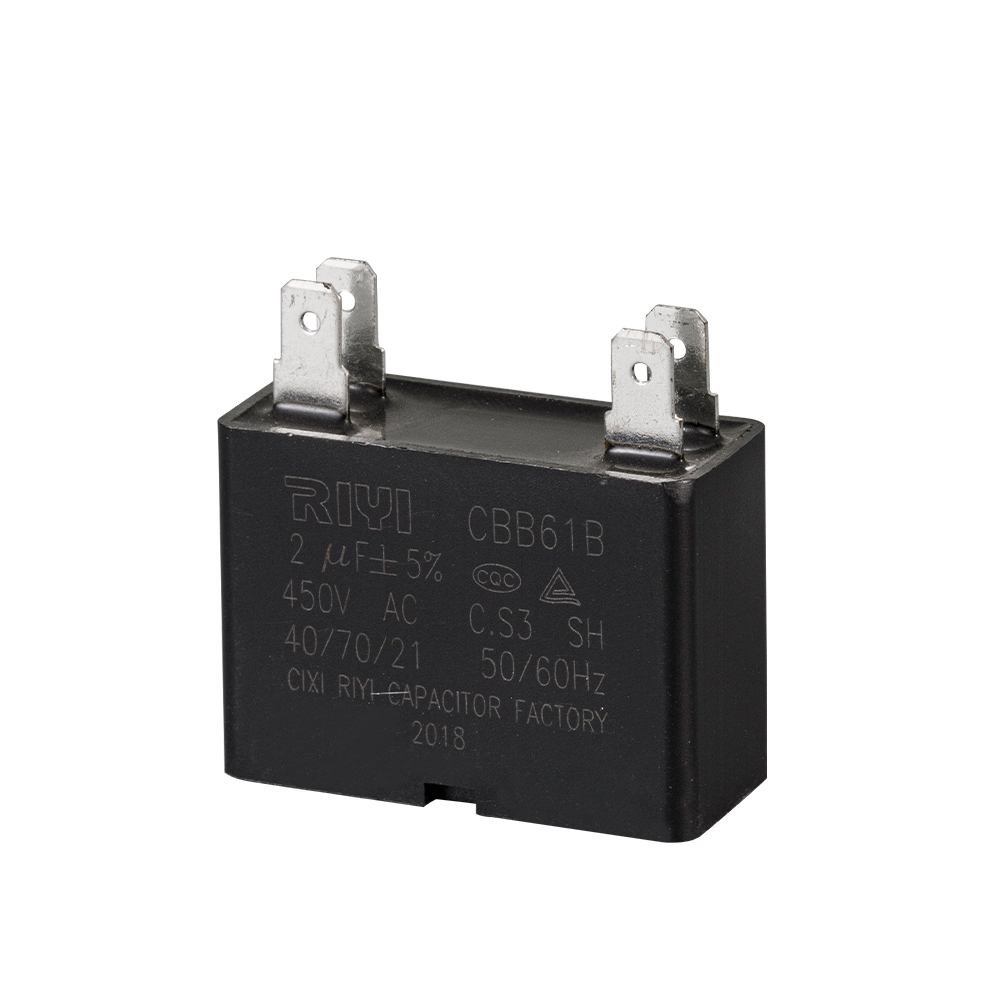 AC Cbb61 Square Motor Fan Capacitor ManufacturerCbb61 2uf 450V S3 2+2 terminal This is a very common starting and running capacitor in power electronic circuits. Simply put, it acts like a "quick-acting accelerator"...View Product →
Key Ratings That Determine Performance and Lifespan
A motor capacitor is not a generic part. Its ratings must match the motor and the application. The table below explains the most important specifications.
| Rating | What It Means | Typical Values | Effect of Wrong Choice |
|---|---|---|---|
| Capacitance | Energy storage per volt | 2 to 80 microfarads | Low torque or high current |
| Voltage | Maximum continuous AC voltage | 250 to 500 VAC | Breakdown and short life |
| Frequency | Design frequency for reactance | 50 or 60 Hz | Overheating or weak torque |
| Tolerance | Allowed deviation from nominal | plus or minus 5% | Mismatched performance |
| Temperature | Maximum case temperature | 85 C or 105 C | Early failure in hot areas |
International standards such as IEC 60252-1 and UL810 define testing requirements for AC motor capacitors. A capacitor marked with a higher voltage rating, for example 450 VAC in place of 370 VAC, is generally safe to use as long as the capacitance matches. A higher capacitance, however, is not a harmless upgrade. It increases the current in the auxiliary winding and can raise winding temperature by 10 to 20 degrees Celsius, which shortens motor life.
How Capacitance Value Affects Torque, Speed, and Efficiency
The capacitance value sets the phase shift and therefore the starting torque. For a typical 1/3 horsepower single-phase motor, a run capacitor around 15 microfarads is common. A 1/2 horsepower motor often uses 20 to 25 microfarads. If you install a capacitor that is too small, the motor may start slowly, run at reduced speed under load, or draw higher current because the phase shift is insufficient.
If the capacitor is too large, the auxiliary winding current becomes excessive. The motor may start with a noticeable jerk, run hotter than normal, and consume more power. In extreme cases, the auxiliary winding insulation fails. A practical rule is to stay within plus or minus 10% of the original capacitance for a run capacitor and within plus or minus 20% for a start capacitor, unless the motor manufacturer specifies otherwise.
Efficiency also depends on the capacitor. A correctly sized run capacitor improves power factor, which reduces the current drawn from the supply for the same mechanical output. This is especially important for pumps and compressors that run for hours each day. A degraded capacitor with capacitance drift of 20% or more can increase energy consumption by 5% to 10% and raise operating temperature.
Failure Modes and Symptoms: What a Bad Motor Capacitor Looks Like
A failing motor capacitor rarely dies silently. The most common symptoms are:
- The motor hums but does not start.
- The motor starts slowly or needs a manual push.
- The motor runs hot or trips a thermal overload.
- The capacitor case is bulged, cracked, or leaking oil.
- The motor draws higher current than the nameplate rating.
To test a capacitor, disconnect power, discharge the terminals with an insulated resistor, and use a multimeter with a capacitance mode. A reading more than 10% below the rated value means the capacitor has lost capacitance and should be replaced. An open circuit or a short circuit is a definite failure. For a complete step-by-step test procedure, see how to test a capacitor with a multimeter.
How to Match a Replacement Capacitor: A Practical Checklist
When ordering a replacement, follow these steps in order. Skipping one can lead to a second failure within weeks.
- Read the original capacitance in microfarads. Match it within plus or minus 5% for run capacitors.
- Check the voltage rating. Equal or higher is acceptable. Never go lower.
- Confirm the frequency rating. A 50 Hz capacitor on a 60 Hz supply will have lower reactance and may overheat.
- Measure the case diameter and length. The replacement must fit the mounting bracket or compartment.
- Match the terminal type. Insert terminals, lead wires, and screw terminals are not interchangeable without adapters.
- Verify the temperature rating. For outdoor or high-load applications, choose 105 C rather than 85 C.
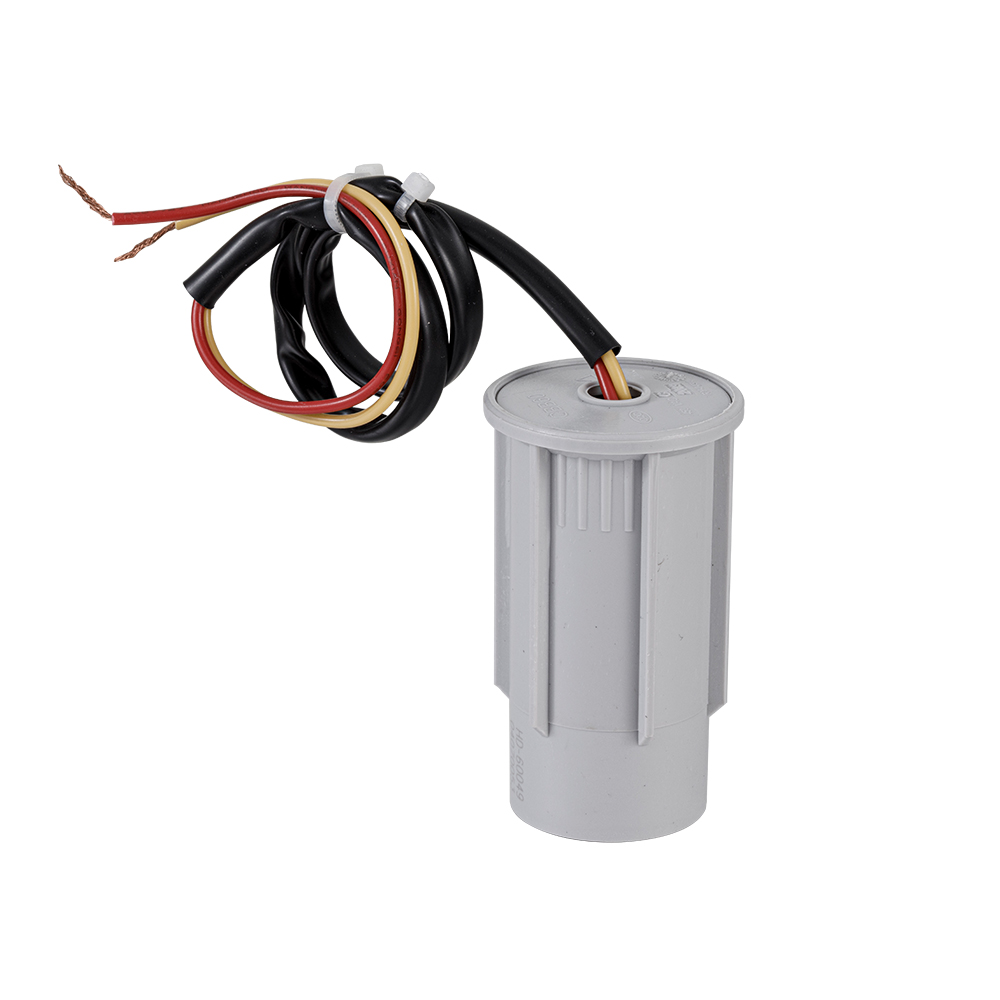
If the motor is a dual-run design, the replacement must have two capacitance values. For example, a 35/5 microfarad capacitor provides 35 microfarads for the compressor and 5 microfarads for the fan. Installing a single-value capacitor will leave one winding without proper phase shift. For washing machine and water pump motors, pay attention to mounting ears, oil resistance, and lead length. The CBB60 series from CIXI RIYI Capacitor Factory includes aluminum case and plastic case options with double lead, insert terminal, and application-specific variants for coolers, washing machines, and water pumps.
Why Manufacturing Quality and Testing Matter for Motor Capacitors
Two capacitors can carry the same 10 microfarad, 450 VAC label and behave very differently after 5,000 hours of operation. The difference comes from film quality, winding tension, impregnation, and end-sealing. A poorly sealed capacitor absorbs moisture, which raises leakage current and accelerates self-healing until the capacitance drops below the motor’s minimum. A well-made capacitor maintains its value within a few percent for tens of thousands of hours.
CIXI RIYI Capacitor Factory operates a 25,000 square meter production facility and ships more than 25 million capacitors per year. The company holds ISO9001 and ISO14001 certifications, and its products carry CQC, TUV, VDE, IMQ, UL, and CE marks. For engineers and repair professionals, that means documented testing and traceable materials. You can learn more about CIXI RIYI Capacitor Factory and its AC motor capacitor lines on the main site.
The product range covers CBB60 AC motor capacitors for pumps and washing machines, CBB61 square motor capacitors for fans and blowers, CBB65 explosion-proof capacitors for air conditioning and compressors, and CBB80 lamp power factor compensation capacitors. Each family is available in multiple case styles, terminal arrangements, and capacitance values. For high-volume OEM production, consistent capacitance tolerance and stable self-healing behavior reduce warranty returns and field failures.
Frequently Asked Questions
Can a motor run without a capacitor?
A single-phase induction motor cannot start without a capacitor or some other phase-splitting method, such as a shaded pole or a resistance start winding. Once running, some motors can continue without the capacitor if the load is light, but they will lose torque and draw higher current. Three-phase motors do not need a capacitor because their supply already creates a rotating field.
What happens if I use a capacitor with higher capacitance?
A higher capacitance increases the current in the auxiliary winding. The motor may start with more torque, but it will run hotter and less efficiently. In continuous-duty applications, the extra current can overheat the auxiliary winding and cause premature failure. For run capacitors, stay within 10% of the original value.
How do I discharge a motor capacitor safely?
Disconnect power and wait at least five minutes for the bleeder resistor, if present, to discharge the capacitor. Then use an insulated wire with a 10,000 ohm to 100,000 ohm resistor to short the terminals. Do not short the terminals directly with a screwdriver; the spark can damage the capacitor and injure your hands. Always verify zero voltage with a multimeter before touching the terminals.
Do all AC motors have capacitors?
No. Three-phase motors do not use capacitors. Small single-phase motors may use a shaded pole or a resistance start winding instead of a capacitor. Capacitor-run and capacitor-start motors are common for pumps, compressors, fans, and appliances because they offer higher starting torque and better efficiency than resistance-split designs.
How long does a motor capacitor last?
A quality run capacitor in a clean, cool environment can last 10 to 20 years. In high-temperature or high-humidity locations, or in motors that start and stop frequently, the life may be 3 to 7 years. Start capacitors usually last as long as the motor because they are only in the circuit for seconds at a time. If a capacitor fails within a year, check for overvoltage, excessive ambient temperature, or a motor fault that is drawing too much current.
Can I replace a run capacitor with a start capacitor?
No. Start capacitors have a much higher capacitance and a short-duty rating. They will overheat and fail quickly if left in a continuous run circuit. A run capacitor can sometimes be used as a temporary start capacitor if its voltage and capacitance are within range, but it is not a reliable or safe permanent solution. Always replace like with like.
Putting It Together: Matching the Capacitor to the Motor
A motor capacitor is a small but critical part of the motor circuit. It creates the phase shift that produces starting torque, improves running torque, and helps the motor use energy efficiently. The three numbers that matter most are capacitance in microfarads, voltage rating, and frequency. Get those wrong and the motor will tell you through noise, heat, or a refusal to start.
For replacements, match capacitance within tolerance, choose a voltage rating equal to or higher than the original, and confirm the physical size and terminal type. For new designs, consider the duty cycle, ambient temperature, and mounting environment. Explosion-proof CBB65 capacitors for compressors, oil-resistant CBB60 capacitors for pumps, and square CBB61 capacitors for fans all exist because different applications impose different stresses.
With a basic understanding of how the capacitor works, you can diagnose failures faster, avoid mismatched parts, and keep single-phase motors running for their full service life.




- Tel: +86-13600614158
- E-mail: mina@cxriyi.com
- Address: Zonghan Street,Cixi City, Zhejiang Province, China.
Copyright © CIXI RIYI CAPACITOR FACTORY
All Rights Reserved.
 custom air conditioner capacitor for sale
China Ac Motor Capacitor Factory