
 en
en
 English
Is a CBB60 a start or run capacitor?
Direct Answer: Is the CBB60 a Start or Run Capacitor?
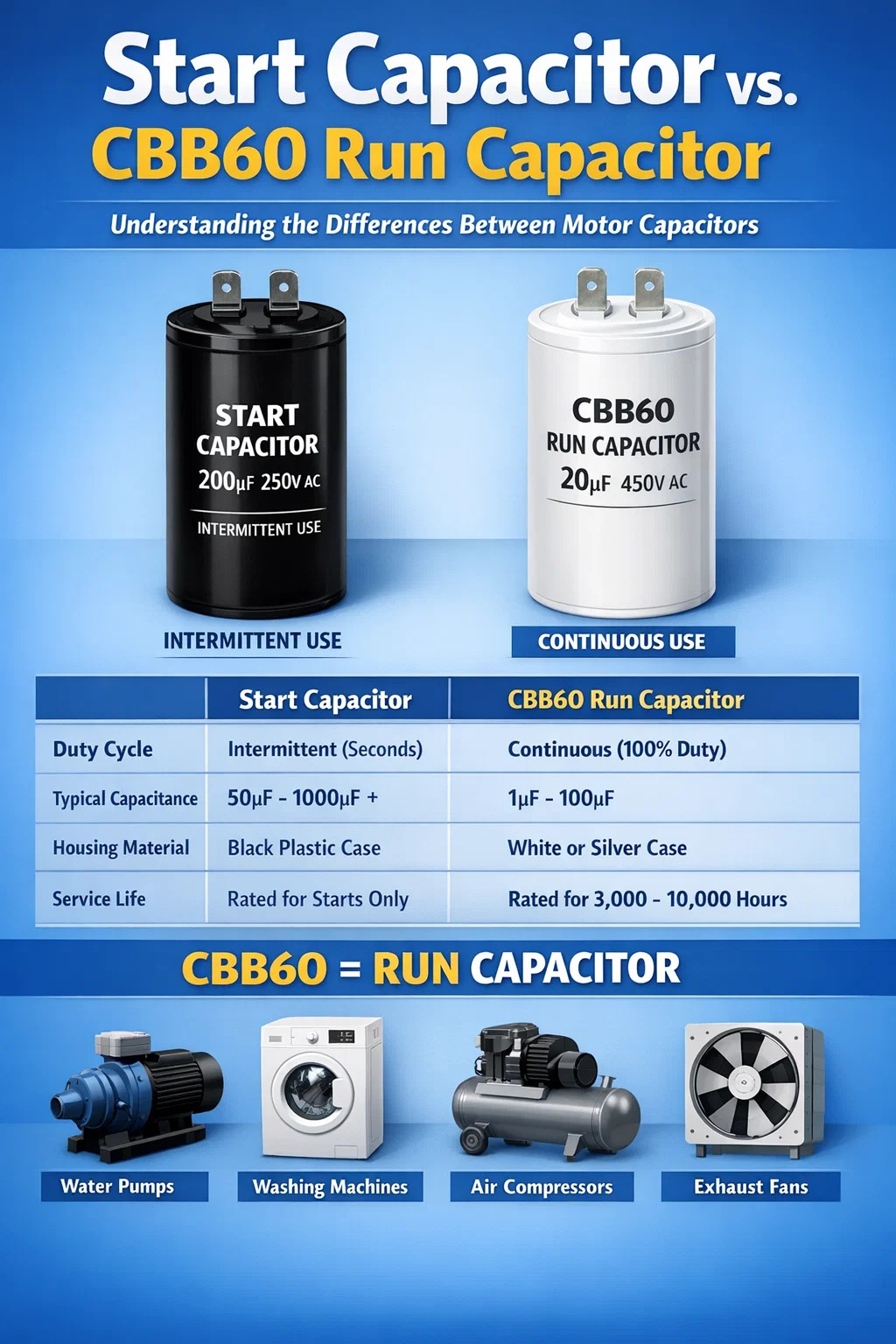
The CBB60 capacitor is fundamentally a run capacitor. While it assists during the initial startup of a motor, its primary engineering purpose is to remain energized and connected to the motor circuit throughout the entire duration of the motor's operation. Unlike a start capacitor, which is disconnected by a centrifugal switch once the motor reaches roughly 75% of its rated speed, the CBB60 provides a continuous phase shift to maintain torque, improve efficiency, and reduce vibration in single-phase AC induction motors.
Understanding the Technical Construction of CBB60
To appreciate why the CBB60 capacitor is categorized for "run" duty, one must look at its internal materials. The name "CBB" itself follows the Chinese industrial standard for capacitor naming: "C" stands for capacitor, the first "B" denotes a polypropylene dielectric, and the second "B" indicates it is a non-polar metallized film type.
Metallized polypropylene film is chosen because it can withstand the constant heat and electrical stress of continuous operation. Run capacitors typically have a lower capacitance range (usually 1µF to 100µF) compared to start capacitors, which often reach several hundred microfarads. This lower capacitance allows the CBB60 to stay in the circuit without causing the motor windings to overheat.
Functional Differences: Start Capacitor vs. CBB60 Run Capacitor
It is common for users to confuse these two components because they both assist motors. However, their electrical "stamina" is very different. Using a start capacitor in place of a CBB60 capacitor would result in a catastrophic failure within minutes because start capacitors are not designed to dissipate the heat of continuous AC current.
| Feature | Start Capacitor | CBB60 Run Capacitor |
|---|---|---|
| Duty Cycle | Intermittent (Seconds) | Continuous (100% Duty) |
| Typical Capacitance | 50µF - 1000µF+ | 1µF - 100µF |
| Housing Material | Usually Black Plastic | Cylindrical White/Silver |
| Service Life | Rated for Starts/Hour | Rated for 3,000 to 10,000 Hours |
Typical Applications for CBB60 Capacitors
Because the CBB60 capacitor is built for continuous run duty, it is found in appliances that require a steady, efficient rotational force. These are machines where the motor might run for hours at a time, such as:
- Domestic Water Pumps: Ensuring constant water pressure in home systems.
- Washing Machines: Managing the continuous drum rotation and agitation cycles.
- Air Compressors: Providing the necessary run-torque to keep the piston moving against pressure.
- Industrial Exhaust Fans: Maintaining steady airflow in ventilation systems.
Interpreting CBB60 Technical Labeling
When you inspect a CBB60 capacitor, the label contains vital information that confirms its status as a run capacitor. You will typically see a voltage rating, such as 450VAC, and a capacitance value like 40µF. More importantly, you will see a Class rating:
Service Life Classes
The EN60252-1 standard often appears on these labels, defining how long the capacitor is expected to last under continuous load:
- Class A: 30,000 hours
- Class B: 10,000 hours
- Class C: 3,000 hours
This long-term hourly rating is a definitive proof that the CBB60 capacitor is meant for running, not just starting.
What Happens if a CBB60 Capacitor Fails?
Since the CBB60 capacitor is a run capacitor, its failure usually manifests during operation or prevents a "weak" motor from overcoming its initial load. Without the phase shift provided by the capacitor, the motor will lose efficiency, run much hotter, and may eventually vibrate excessively until the thermal protection trips.
Common Failure Signs
If your equipment is acting up, look for these specific issues related to the CBB60 capacitor:
- The motor hums but requires a manual "push" to start spinning.
- The motor shuts off randomly due to overheating.
- Visible bulging or leaking from the cylindrical shell of the capacitor.
- The capacitor measures significantly lower than its rated microfarad value on a multimeter.

- Tel: +86-13600614158
- E-mail: mina@cxriyi.com
- Address: Zonghan Street,Cixi City, Zhejiang Province, China.
Copyright © CIXI RIYI CAPACITOR FACTORY
All Rights Reserved.
