
 en
en
 English
CBB65B Capacitor Guide: Specs, Sizing & Replacement Tips
What a CBB65B Capacitor Actually Does
A cbb65b capacitor is a metallized polypropylene film capacitor built to start and continuously run single-phase AC motors, most commonly the compressor and condenser fan inside air conditioners and heat pumps. It comes in two configurations: a single-value version wired to one motor, and a dual-value version that combines two capacitance ratings in one round aluminum can to serve both the compressor and the fan motor at the same time. Rated voltage is almost always 370V or 440V AC, and capacitance typically falls between 1.5 µF and 100 µF depending on motor size.
Unlike a start capacitor that disconnects once a motor reaches speed, a cbb65b capacitor stays in the circuit for the entire run cycle. That continuous duty is exactly why capacitance drift, heat, and case swelling are the failure patterns to watch for, and why matching the exact rating during replacement matters more than it does for a start-only component.
The component sits on nearly every split-system and packaged residential air conditioner produced in the last two decades, along with a large share of light commercial rooftop units, heat pumps, and refrigeration condensing units. Because the part is so widely standardized, a correctly matched cbb65b capacitor from one manufacturer will generally perform the same as one from another manufacturer, provided the capacitance, voltage, and case dimensions line up.
CBB65B Capacitor Core Specifications
The table below summarizes the specification ranges you will see printed on the label of a typical cbb65b capacitor.
| Parameter | Typical Range | Notes |
|---|---|---|
| Capacitance | 1.5 µF – 100 µF | Single value or dual value (e.g. 35+5 µF) |
| Voltage Rating | 370V / 440V AC | Some industrial variants extend to 660V AC |
| Tolerance | ±5% to ±6% | Tighter tolerance generally means steadier motor torque |
| Frequency | 50/60 Hz | Dual-frequency rating covers most residential grids |
| Operating Temperature | -40°C to +85°C | Outdoor condenser units see the upper end in summer |
| Case Style | Round or oval, aluminum | Sizes commonly range from about 35mm to 60mm diameter |
| Dielectric | Metallized polypropylene film | Self-healing property limits damage from minor internal arcing |
| Mounting | Stud-and-bracket or strap | Stud thread size is normally 8mm or 10mm |
| Terminal Type | Quick-connect spade | Common spade widths are 0.187 inch (small) and 0.25 inch (large) |
Many CBB65B capacitors also include an internal pressure-sensitive disconnect. If internal gas pressure builds from prolonged overheating or age-related breakdown, this mechanism opens the circuit and disconnects the capacitor rather than letting the case rupture near live wiring. The dielectric film itself is described as self-healing: a minor internal breakdown vaporizes a tiny spot of metallization instead of causing a full short, which is part of why a cbb65b capacitor tends to fail gradually through capacitance drift rather than instantly.
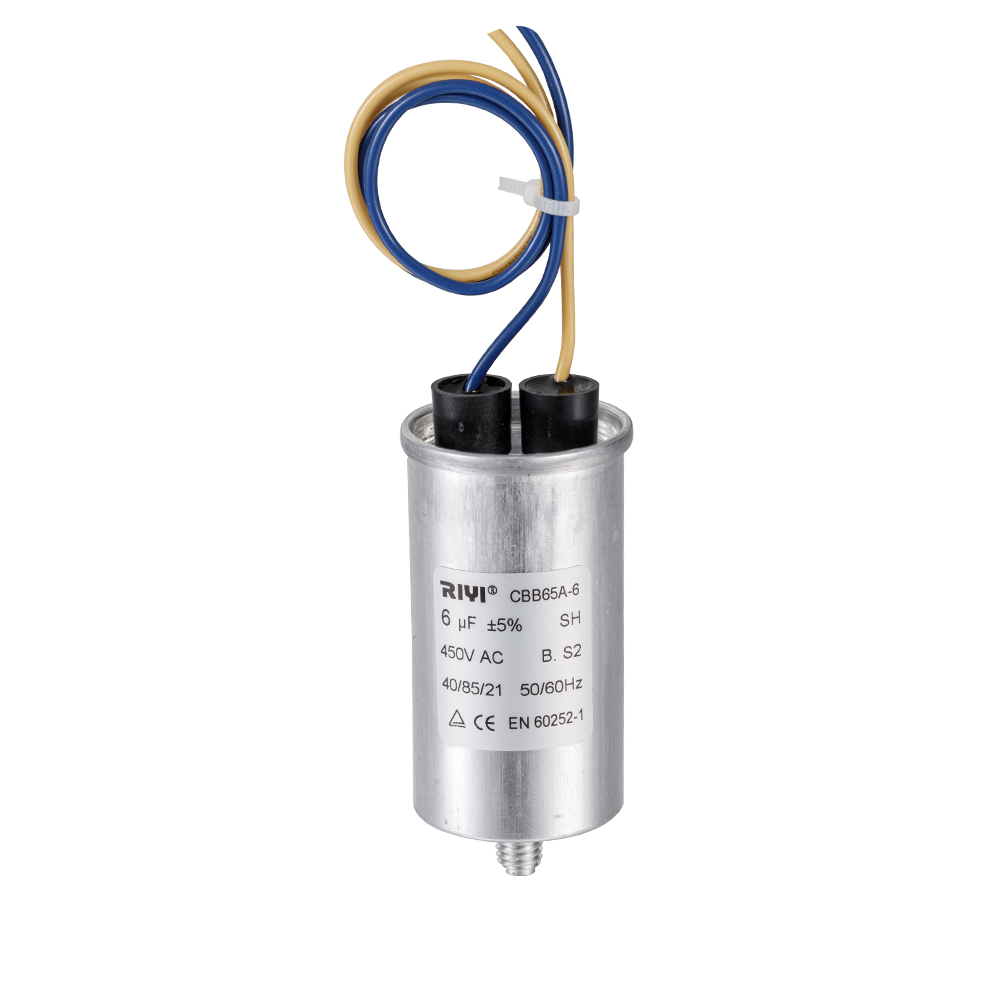
Single-Value and Dual-Value CBB65B Capacitor Designs
Single Run CBB65B Capacitor
- Two terminals, one capacitance value
- Wired to a single motor, most often a condenser fan
- Common values sit between 3 µF and 15 µF for fan-only duty
- Smaller case footprint, easier to source as a universal fan replacement
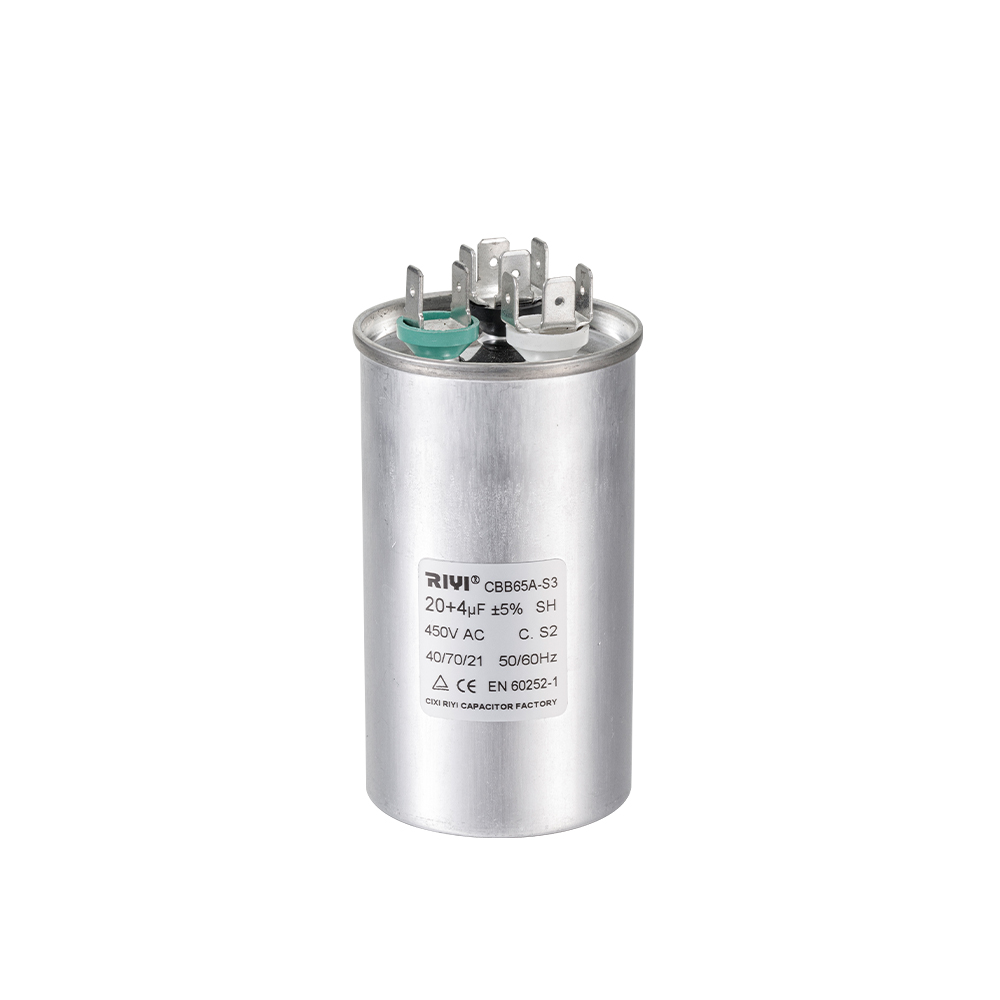
Dual Run CBB65B Capacitor
- Three terminals marked C, HERM, and FAN
- Combines a higher value for the compressor and a lower value for the fan in one case
- Reduces wiring complexity and mounting hardware inside the unit
- A single failed terminal set does not always affect the other, but replacement is usually done as a full unit
The terminal marked C is the common connection shared by both capacitance values on a dual run cbb65b capacitor, HERM feeds the compressor (hermetic motor), and FAN feeds the condenser fan motor. Confusing these three terminals during reinstallation is one of the most frequent wiring mistakes on service calls, so labeling wires before disconnecting the old capacitor is worth the extra minute.
Run Capacitor vs Start Capacitor: Where CBB65B Fits
Motor capacitors split into two functional families, and a cbb65b capacitor belongs firmly to the run category rather than the start category. The distinction matters because the two types are not interchangeable despite sometimes looking similar.
| Characteristic | Run Capacitor (CBB65B) | Start Capacitor |
|---|---|---|
| Duty cycle | Continuous, stays energized while the motor runs | Momentary, disconnects within a second or two of startup |
| Dielectric | Metallized polypropylene film | Electrolytic |
| Capacitance range | 1.5 – 100 µF | Often 88 – 400+ µF |
| Typical failure mode | Gradual capacitance drift, case swelling | Rapid failure, frequently after cycling many times |
| Where it connects | Wired continuously between run winding and line | Wired through a relay or switch that drops it out after startup |
Installing a start capacitor in place of a cbb65b capacitor, or the reverse, will damage the motor windings quickly because the duty cycle and internal construction are built for entirely different jobs.
How a CBB65B Capacitor Keeps a Single-Phase Motor Running
A single-phase AC motor cannot generate a rotating magnetic field on its own; without a phase shift between windings, it simply hums and stays still. A cbb65b capacitor solves this by feeding a leading current into the auxiliary winding, creating the phase difference needed to produce rotational torque.
- Power reaches the main winding and the auxiliary winding at the same time.
- The capacitor shifts the current in the auxiliary winding ahead of the main winding.
- That phase offset produces a rotating magnetic field strong enough to start the rotor turning.
- The capacitor remains in circuit continuously, sustaining torque and smoothing current draw for as long as the motor runs.
- Any drift in capacitance changes that torque balance, which is why a weak cbb65b capacitor produces symptoms like slow starts or excess motor heat long before it fails outright.
Because the phase shift also improves the motor's running power factor, a correctly rated cbb65b capacitor does more than just enable startup. It reduces the current the motor draws for a given torque output, which is part of why a badly drifted capacitor shows up on an electric bill before it shows up as an outright no-start complaint.
Common Capacitance and Voltage Combinations
| Capacitance | Voltage | Typical Application |
|---|---|---|
| 5 µF | 370V | Small condenser fan motors |
| 7.5 µF | 370/440V | Mid-size condenser fan motors |
| 35+5 µF (dual) | 370/440V | Residential split-system compressor and fan |
| 40+5 µF (dual) | 370/440V | Slightly larger residential split systems |
| 45 µF | 440V | Mid-size residential compressor |
| 55+15 µF (dual) | 250V | Larger residential or light commercial units |
| 70+5 µF (dual) | 440V | Larger split systems and heat pumps |
| 80 µF | 440V | Commercial compressor motors |
These values are common reference points rather than universal defaults. The equipment nameplate or original capacitor label is always the deciding factor, since two air conditioners with similar cooling capacity can still specify different capacitance depending on compressor design and motor efficiency class.
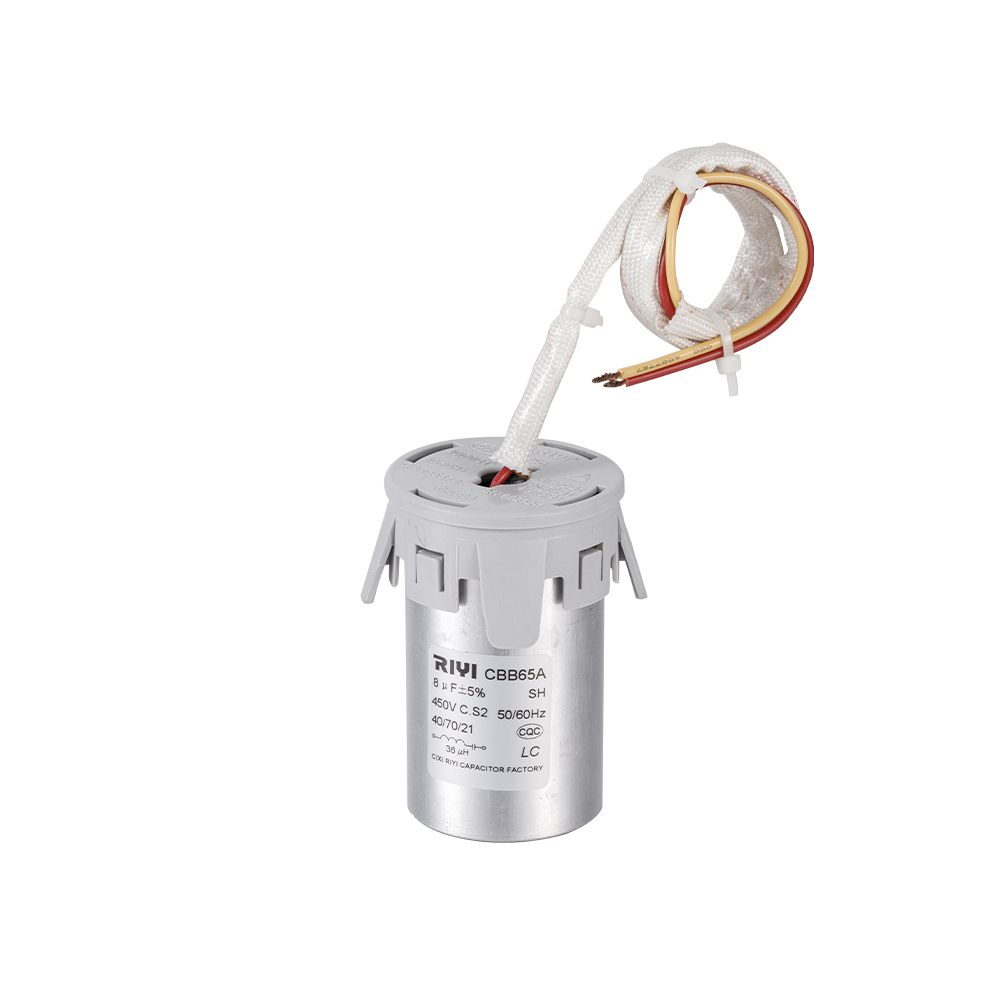
Recognizing Compressor-Side vs Fan-Side Failure Symptoms
On a dual run cbb65b capacitor, the compressor-side and fan-side capacitance values can drift independently, and each produces a different symptom pattern.
| Symptom | Likely Affected Side |
|---|---|
| Compressor hums but never engages | HERM (compressor) side |
| Breaker trips a few seconds after startup | HERM (compressor) side |
| Fan blade spins slowly or needs a manual push | FAN side |
| Unit runs but the fan is noticeably slower than normal | FAN side |
| System runs continuously without shutting off, poor cooling | Either side, check both readings |
Warning Signs of a Failing CBB65B Capacitor
- The compressor hums but the unit never actually starts
- The condenser fan turns slowly or needs a manual push to start spinning
- The breaker trips repeatedly at startup
- The top of the capacitor case looks swollen or domed instead of flat
- Oily residue is visible around the base or terminals
- A burning smell comes from the outdoor unit cabinet
- Cooling output drops even though the system keeps running
- The system short-cycles, turning on and off in rapid, unusually short bursts
- Higher than normal energy usage for the same runtime
Any one of these signs on its own is worth investigating. A bulging case in particular almost always means the capacitor is past useful life, even if it still measures close to its rated value.
Testing a CBB65B Capacitor With a Multimeter
- Cut power to the outdoor unit at the breaker and confirm the disconnect is off.
- Discharge the capacitor terminals fully using an insulated resistor tool before touching any leads.
- Set a multimeter with a capacitance function to the microfarad range.
- Touch the probes to each terminal pair and record the reading for every capacitance value printed on the label.
- Compare each reading against the rated value and its printed tolerance, typically ±5% to ±6%.
- Replace the capacitor if any reading falls more than about 10% outside its rated value, or reads zero or open.
On a dual run cbb65b capacitor, test the C-to-HERM pair and the C-to-FAN pair separately. It is common for one side to test within tolerance while the other has drifted, and both values need to be within range before the capacitor is considered good.
Step-by-Step CBB65B Capacitor Replacement Procedure
- Confirm the exact replacement part matches capacitance, voltage, and configuration before starting the swap.
- Disconnect power at the breaker and verify with a meter that no voltage is present at the unit.
- Discharge the old capacitor fully using an insulated resistor tool.
- Photograph or label each wire before disconnecting it from the C, HERM, and FAN terminals.
- Remove the mounting strap or bracket and take out the old capacitor.
- Set the new cbb65b capacitor in the bracket in the same orientation as the original.
- Reconnect each wire to the matching terminal based on the photo or labels taken earlier.
- Secure the mounting strap so the capacitor cannot shift or vibrate loose.
- Restore power and observe a full startup cycle to confirm normal compressor and fan operation.
How Climate and Installation Location Affect Service Life
| Condition | Effect on Service Life |
|---|---|
| Direct sun exposure with poor airflow | Shortens life due to elevated case temperature |
| Coastal or high-humidity environment | Increases risk of terminal corrosion over time |
| Frequent voltage sags or spikes on the local grid | Accelerates dielectric stress and capacitance drift |
| Shaded, well-ventilated outdoor unit placement | Supports the full expected service life range |
| Frequent short-cycling from an oversized system | Increases thermal stress from repeated startup surges |
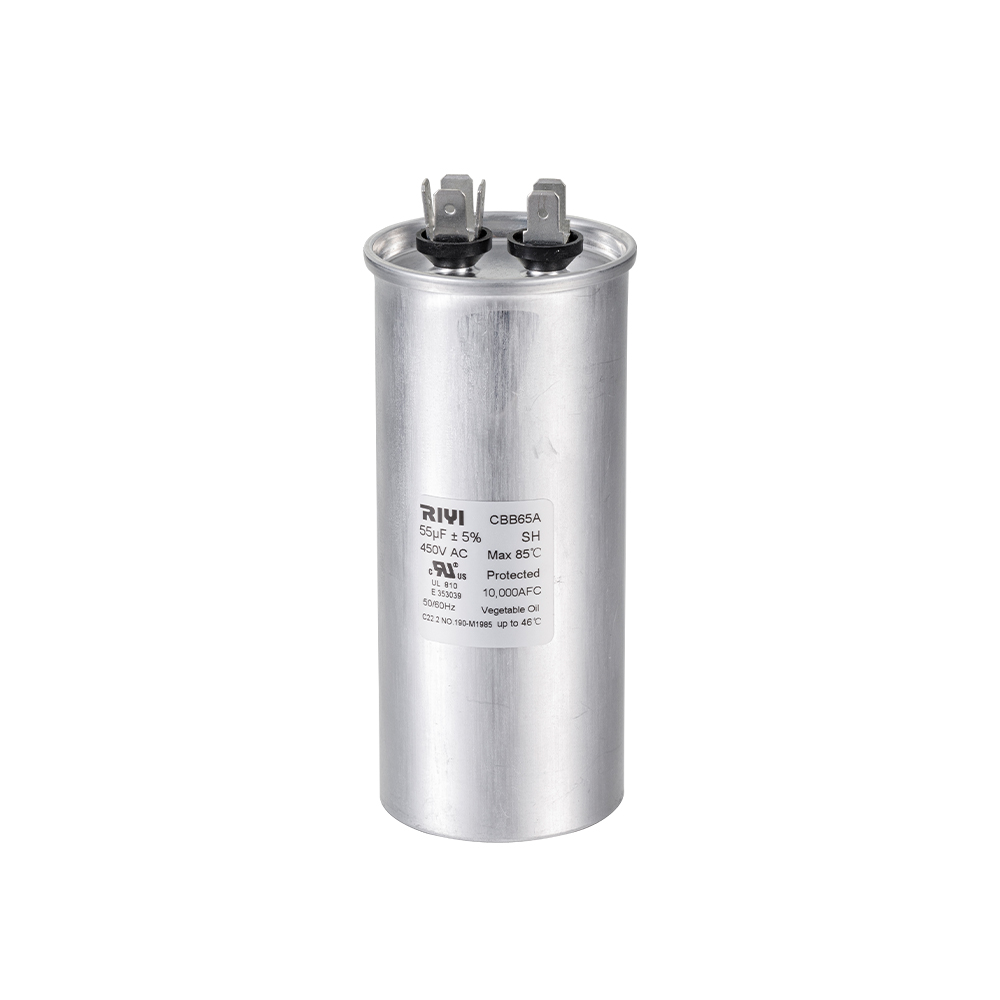
Choosing the Right Replacement CBB65B Capacitor
- Match every capacitance value exactly, not just the largest number on a dual-run label
- Match or exceed the original voltage rating, never install a lower-voltage part
- Confirm single run versus dual run configuration before ordering
- Check case diameter and height against the mounting bracket clearance
- Verify terminal count and spacing so factory wiring connects without modification
- Check the tolerance rating printed on the label matches or improves on the original
CBB65B vs CBB60 vs CBB61: Key Differences
| Type | Typical Voltage | Common Use | Case Style |
|---|---|---|---|
| CBB65B | 370–440V | AC compressor and condenser fan motors | Round or oval aluminum, higher capacitance range |
| CBB60 | 250–450V | General purpose motor run, pumps, small fans | Varies by manufacturer, often rectangular |
| CBB61 | 250–450V | Ceiling fan speed control | Flat plastic case with wire leads, low capacitance |
Installation and Handling Practices
- Reinstall the capacitor in its original bracket orientation to prevent vibration wear
- Keep terminals clear of the metal cabinet panel to avoid accidental shorting
- Use insulated tools and confirm the capacitor is discharged before any contact
- Avoid over-tightening spade connectors, which can crack the terminal post
- Match the C, HERM, and FAN markings to the wiring diagram exactly on dual run units
- Support the capacitor's weight with the mounting bracket rather than the wires alone
Storage and Handling Before Installation
A new cbb65b capacitor sitting on a shelf still needs reasonable care. Store spare units in a dry location away from direct heat sources, since prolonged exposure to high ambient temperature can age the dielectric film even before installation. Keep the capacitor in its original packaging until it is ready to be installed, and avoid dropping or stacking heavy items on top of the case, since a dented or deformed can changes the internal spacing the dielectric relies on. If a spare capacitor has been in storage for several years, testing its capacitance before installation is a reasonable precaution, since film capacitors can drift slowly even without being energized.
Common Misconceptions About CBB65B Capacitors
| Misconception | More Accurate Explanation |
|---|---|
| A slightly higher capacitance value is always fine as a substitute | Even a small increase raises current draw and running temperature over time |
| If the multimeter reading looks close to spec, the capacitor is healthy | A bulging case or oily residue can still mean imminent failure regardless of the reading |
| Any round aluminum capacitor of the right size will work | Capacitance, voltage, and terminal configuration must all match, not just physical size |
| Start capacitors and run capacitors are interchangeable in a pinch | The two are built for different duty cycles and swapping them damages the motor |
What Shortens CBB65B Capacitor Lifespan
Under normal residential duty cycles, a quality cbb65b capacitor commonly lasts 6 to 10 years. Several conditions push that number down significantly: sustained high ambient heat around the outdoor unit, voltage spikes from grid fluctuations, frequent short-cycling of the compressor, operation at or above the rated voltage for extended periods, and vibration that gradually loosens terminal connections. Units installed in direct sun with poor airflow around the cabinet tend to reach capacitor replacement age noticeably sooner than shaded, well-ventilated installations.
Duty cycle also plays a measurable role. A system that cycles on and off frequently throughout the day subjects the capacitor to more startup surges per year than one that runs in longer, steadier stretches, which is part of why oversized or poorly matched systems tend to go through run capacitors faster than correctly sized ones.
Frequently Asked Questions
What does the CBB65B designation actually mean?
The naming follows a film capacitor convention where the first letter marks it as a capacitor, the following letters describe a non-polar organic film with polypropylene dielectric, and the number identifies the specific case and mounting form factor used for AC motor run applications.
Can one single-value CBB65B capacitor replace a dual-run unit?
No. A dual run cbb65b capacitor serves two separate motors from one case. Replacing it with a single-value part leaves one motor without the capacitance it needs, so the replacement must match the original single or dual configuration.
What happens if the capacitance is too high or too low?
Too low, and the motor struggles to reach full torque, runs hotter, and may fail to start under load. Too high, and excess current flows through the auxiliary winding, which raises operating temperature and shortens both motor and capacitor life.
Can a CBB65B capacitor be used on a well pump motor?
Some well pump motors use the same round aluminum run capacitor format, but the capacitance and voltage rating must still match the pump motor's nameplate exactly. Checking the pump manufacturer's specification is the only reliable way to confirm compatibility.
Why does the AC unit still not start after the capacitor was replaced?
A failed capacitor is one of several possible causes of a no-start condition. Contactor issues, a seized compressor, a tripped overload, or wiring faults can produce similar symptoms, so a no-start after replacement usually points to one of these other components.
Is a bulging top always a sign of failure?
A domed or bulging case means internal pressure has built up from heat or aging, and the capacitor should be replaced even if it still tests within tolerance, since case swelling reliably precedes a full failure.
How often should a CBB65B capacitor be checked?
An annual check before peak cooling season catches capacitance drift early. Units in hot climates or with a history of short-cycling benefit from checking twice a year.
Does voltage rating matter if the capacitance is correct?
Yes. Voltage rating determines how much electrical stress the dielectric film can safely absorb, so a capacitor rated below the system's operating voltage can fail quickly even with an otherwise correct capacitance value.
Can a higher voltage rated CBB65B capacitor be used instead of the original?
A higher voltage rating than the original is generally acceptable as long as the capacitance value, tolerance, terminal layout, and case size still match, since the higher rating simply adds margin rather than changing how the capacitor performs.
Why do some CBB65B capacitors have three capacitance values printed on the label?
A dual run unit lists the compressor value, the fan value, and sometimes the combined value for reference, so the two functional values that matter for testing and replacement are the compressor figure and the fan figure, not the combined number.
What is the difference between the rated voltage and the actual line voltage?
Rated voltage is the maximum the capacitor is built to withstand safely, while line voltage is what the electrical system actually supplies. A correctly rated cbb65b capacitor should always have a rated voltage equal to or higher than the line voltage it operates on.

- Tel: +86-13600614158
- E-mail: mina@cxriyi.com
- Address: Zonghan Street,Cixi City, Zhejiang Province, China.
Copyright © CIXI RIYI CAPACITOR FACTORY
All Rights Reserved.
